


Meet the SunRISE Swarm
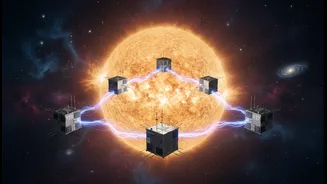
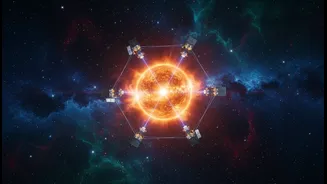
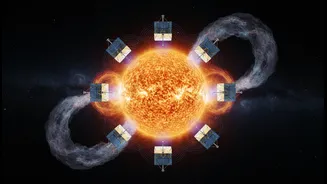
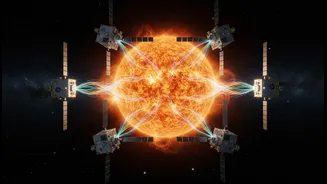
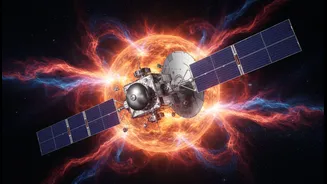
Set to launch in summer 2026, the Sun Radio Interferometer Space Experiment, or SunRISE, isn't a single, monolithic spacecraft. Instead, it’s a coordinated team of six toaster-sized CubeSats. These small satellites will fly in a precise formation about
22,000 miles above Earth, creating a virtual radio telescope spanning over six miles. This innovative approach, known as interferometry, allows the team to achieve the power of a massive observatory without building a single, giant structure. Their mission is to look at the Sun in a way that's impossible from the ground. Earth's ionosphere blocks the low-frequency radio waves that SunRISE is designed to see, which are the tell-tale signs of solar eruptions.
The Threat from Our Star
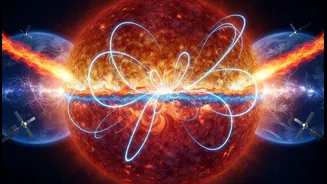
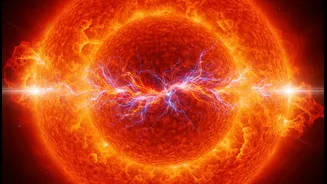
The Sun, the source of all life on Earth, is also a source of immense danger. It regularly unleashes powerful bursts of energy and particles known as solar flares and coronal mass ejections (CMEs). A CME is a massive expulsion of plasma and magnetic fields from the Sun's outer atmosphere. While solar flares travel at the speed of light and can cause radio blackouts on Earth within minutes, CMEs are somewhat slower, taking anywhere from 15 hours to several days to reach us. This travel time provides a crucial, albeit short, window to prepare for their impact. When these solar storms slam into Earth's magnetic field, they can trigger geomagnetic storms with devastating consequences for our technologically dependent society.
A World Held Hostage by Space Weather
The potential damage from a severe solar storm is immense. These events can induce powerful electrical currents in long conductors, threatening to overload power grids and cause widespread blackouts, like the one that left 6 million Canadians in the dark in 1989. Our vast satellite infrastructure is particularly vulnerable. Energetic particles can damage sensitive electronics, disrupt communications, and degrade GPS signals, potentially throwing navigation systems off by dozens of feet. In February 2022, a relatively minor solar storm was enough to disable 40 SpaceX Starlink satellites. For astronauts, especially those outside the protection of Earth's magnetosphere on missions to the Moon or Mars, the radiation from these events can be extremely hazardous.
How SunRISE Acts as an Early Warning System
This is where SunRISE comes in. The mission's primary goal is to help scientists understand the currently mysterious processes that accelerate solar energetic particles during a CME. It does this by tracking the low-frequency radio waves that are emitted near the start of these events. These radio bursts effectively act as a precursor, glowing in the moments before the most dangerous, high-energy particles are launched. By creating a 3D map of where these radio emissions originate, SunRISE can help pinpoint the source of the particle acceleration and track how the storm evolves as it travels through space. This knowledge is the key to transforming our ability to forecast space weather from a rough estimate into a precise science, giving us a better chance to protect our assets and astronauts.
Protecting Our Future in Space and on Earth
As humanity becomes a truly spacefaring species, with plans for lunar bases and missions to Mars, understanding and predicting space weather is not just an academic exercise—it is a matter of survival. Astronauts on long-duration missions will be far more exposed to solar radiation, and reliable forecasts are essential to keeping them safe. On Earth, our increasing reliance on satellite networks for everything from financial transactions to emergency services means the stakes have never been higher. A storm on the scale of the 1859 Carrington Event, which set telegraph offices on fire, could cause trillions of dollars in damage to the modern global economy. Missions like SunRISE represent a critical investment in the resilience of our infrastructure, both on the ground and in orbit.