







The Challenge of Faint Light
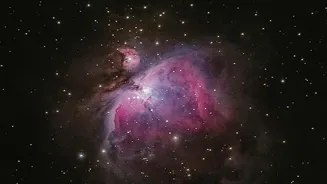
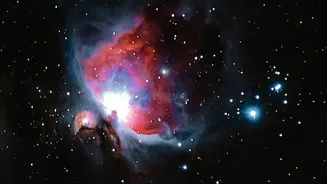
Deep-space objects like nebulae and galaxies are incredibly faint. The light reaching us has travelled for millions of years, becoming diffuse and weak. To our eyes, and to a camera in a quick snapshot, the sky where these objects reside often appears
black and empty. The fundamental challenge for an astrophotographer is to collect enough of these ancient particles of light, called photons, to make the invisible visible. This requires overcoming the limitations of standard photography and embracing techniques specifically designed for the cosmos. It’s a battle against distance, time, and the inherent 'noise' that cameras produce.
The Power of the Long Exposure
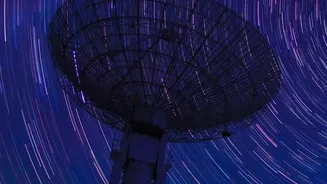
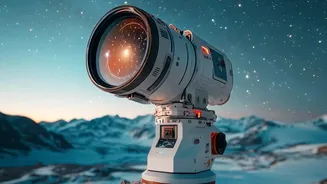
The primary weapon against faintness is the long exposure. By leaving the camera's shutter open for an extended period—from many seconds to several minutes—the sensor can soak up light continuously. Think of it like leaving a bucket out in a light drizzle. A brief moment collects almost no water, but over a long time, the bucket fills. Similarly, a long exposure allows countless photons from a distant galaxy to hit the camera sensor, gradually building up an image. However, this introduces a problem: Earth’s rotation. A static camera will see stars streak across the frame. To counteract this, photographers use tracking mounts that move the camera in sync with the sky, allowing for crisp, pinpoint stars even after many minutes.
Signal vs. Noise: The Golden Ratio
Every digital image is a combination of two things: 'signal' and 'noise'. Signal is the good stuff—the actual light from the stars and nebulae you want to capture. Noise is the unwanted interference. It can come from heat in the camera's electronics (thermal noise) or the process of reading the sensor's data (read noise). In astrophotography, the goal is always to maximize the signal-to-noise ratio (SNR). A high SNR means your image is clean, with clear details. A low SNR means the faint details of your target are lost in a sea of grainy, colourful speckles. Long exposures help by increasing the signal, but they also increase thermal noise.
The Magic of Stacking Images
So, how do you boost the signal without being overwhelmed by noise? The answer is image stacking. Instead of taking one extremely long exposure, photographers take many shorter ones, often dozens or even hundreds. These individual shots are called 'light frames'. Using specialized software, these frames are precisely aligned and averaged together. Because the signal (the galaxy) is in the same place in every photo, it gets stronger and clearer with each added frame. The noise, however, is random in each shot. When averaged, the random noise patterns cancel each other out, effectively fading into the background. This process dramatically increases the signal-to-noise ratio, revealing faint structures that were completely invisible in any single frame.
Using Calibration to Clean Up
To take stacking even further, photographers use calibration frames. 'Dark frames' are taken with the lens cap on, at the same exposure time and temperature as the light frames, to capture just the thermal noise pattern, which can then be subtracted. 'Bias frames' are taken at the camera’s fastest shutter speed to capture the sensor's inherent read noise. 'Flat frames' are taken of a uniform light source to map out dust spots on the sensor and vignetting from the lens. By subtracting these noise patterns and correcting for optical imperfections, the final stacked image becomes remarkably clean, allowing the true, faint signal to shine through with incredible clarity.
Aperture and ISO: The Supporting Roles
While exposure time and stacking are the main players, aperture and ISO are crucial supporting characters. Aperture (measured in f-stop) is the size of the opening that lets light into the camera. A wider aperture (a lower f-number, like f/2.8) gathers light more quickly, which is a huge advantage. ISO controls the sensitivity of the camera's sensor. A higher ISO amplifies the signal, making faint objects visible faster, but it also amplifies noise. Photographers must find a 'sweet spot', often around ISO 800 or 1600 for many cameras, that provides enough sensitivity without introducing excessive noise that stacking can't overcome.