


The Constant Question
Since Sir Isaac Newton, we have understood gravity through a fundamental number known as the gravitational constant, or 'Big G'. This value dictates the strength of the gravitational force between two objects, whether they're apples falling from a tree
or stars dancing around a galactic center. For centuries, this constant has been a pillar of physics. Yet, some theories, including those from physicist Paul Dirac, have speculated that 'Big G' might not be truly constant, potentially changing over cosmic time. If gravity's strength has varied throughout the universe's history, it would revolutionize our understanding of cosmic evolution, from the Big Bang to the present day.
A Cosmic Laboratory
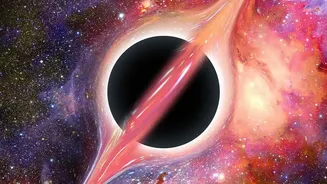
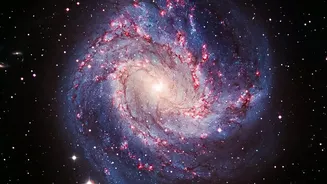
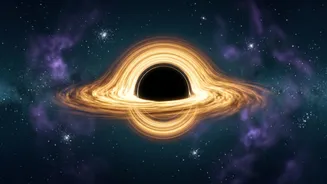
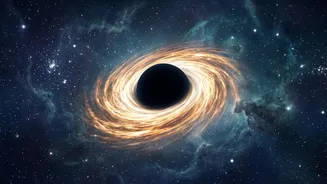
To test this profound question, astronomers need a stable, long-term experiment. They find it in the stars. For more than two decades, independent teams of astronomers have been meticulously tracking the orbits of stars at the heart of our Milky Way galaxy. These stars, particularly those whipping around the supermassive black hole Sagittarius A*, serve as exquisite probes of gravity in an extreme environment. By precisely measuring the paths of these stars over many years, scientists can see if their orbits follow the exact ellipses predicted by Newton's and Einstein's theories or if there are any deviations that might hint at a change in gravity's fundamental strength.
The Stellar Dance
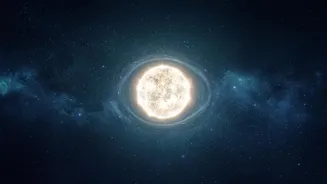
Imagine watching a spinning top. A perfect top on a perfect surface spins smoothly. But if the surface is uneven or the top is imbalanced, it begins to wobble. Similarly, if the force of gravity were to change, even slightly, it would introduce a 'wobble' into a star's orbit. Over a long enough period, this would cause the orbit to shift in a way that standard theories cannot explain. One of the most famous subjects of this research is the star S0-2, which completes an orbit of our galaxy's central black hole every 16 years. Decades of observation have allowed astronomers to map its path with incredible precision, checking for any such anomalies.
So, Does Gravity Vary?
The results from these long-term studies are complex. On the one hand, observations of distant pulsars—super-dense, rapidly spinning stars—over 21 years have shown that the gravitational constant appears to be remarkably stable, holding true across vast cosmic distances. Likewise, large-scale surveys of how galaxy clusters move are also consistent with gravity behaving as expected. However, Earth-based experiments to measure 'Big G' precisely have yielded frustratingly inconsistent results for decades, leading some to wonder if we are missing some piece of the puzzle. The discrepancies in these lab measurements are far larger than experimental errors should allow, leaving the door open to more exotic explanations, including the possibility that G itself fluctuates.
The Quest Continues
While observations of stellar orbits have largely reinforced the idea that gravity is constant, the mystery is far from solved. The puzzling results from laboratory measurements of 'Big G' ensure scientists will keep investigating. Future observations with even more powerful instruments will allow astronomers to track stars in even tighter orbits around black holes, testing the laws of gravity with higher precision than ever before. These studies don't just refine a number; they test the very foundation of our cosmic model. Each measurement is an opportunity to confirm our understanding of the universe or, more excitingly, to discover that the rules are different from what we imagined.