



More Than Just Pretty Pictures
When you see a breathtaking image of a galaxy or nebula released by NASA, it's easy to be mesmerized by the vibrant swirls of color. But these colors are more than just artistic choices; they are a vital form of scientific data. In a timely celebration
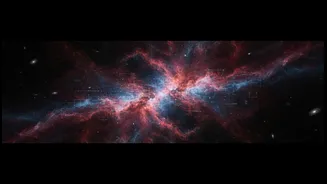
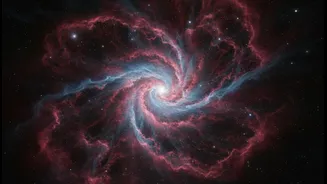
for the United States' 250th birthday, NASA recently highlighted several cosmic objects using a palette of red, white, and blue. This wasn't just for show. This color scheme helps astronomers visualize and interpret complex information captured by telescopes like the Chandra X-ray Observatory and the James Webb Space Telescope (JWST). By assigning colors to different wavelengths of light, including those invisible to the human eye like X-rays and infrared, scientists can tell a story about what an object is made of, its temperature, and its history.
Decoding the Cosmic Colors
In astronomy, color is a code. The rule of thumb is often the opposite of what you might expect: red usually means cooler, while blue indicates hotter temperatures. Reddish colors in a galaxy can signify older, cooler stars or vast clouds of hydrogen gas, which is the primary fuel for star formation. Blue, on the other hand, points to the presence of massive, young, intensely hot stars that burn through their fuel quickly. White or yellowish areas often show a dense concentration of many types of stars mixed together, where their collective light blends into a whitish glow. For example, a recent Hubble image of the stellar nursery LH 95 shows brilliant blue and white stars sparkling against crimson clouds of gas, perfectly illustrating how these colors map to cosmic activity. These color assignments allow astronomers to instantly identify regions of active star birth, differentiate between young and old stellar populations, and trace the structure of a galaxy.
Peering Back to the Dawn of Time
The James Webb Space Telescope, with its powerful infrared vision, has been instrumental in pushing our cosmic frontier back to the very first galaxies. These ancient objects are so far away that the expansion of the universe has stretched their light into the redder end of the spectrum—a phenomenon called redshift. Recently, JWST identified what is currently the most distant galaxy ever observed, JADES-GS-z14-0, which existed less than 300 million years after the Big Bang. In the false-color images, this record-breaking galaxy appears as a distinct red blob, a direct consequence of its immense distance. The surprising brightness and size of JADES-GS-z14-0 and other early galaxies are challenging current theories, suggesting that the first stars and galaxies formed much faster and grew more robustly than previously imagined.
Mysterious 'Little Red Dots'
Beyond simply being distant, some reddish objects are proving to be entirely new cosmic puzzles. The JWST has discovered hundreds of mysterious objects dubbed "little red dots." These compact, reddish objects were common in the early universe but seem to have disappeared since. Scientists are now finding strong evidence that these aren't just tiny galaxies. Instead, they may be a new class of object altogether: rapidly growing supermassive black holes shrouded in thick cocoons of gas and dust. This theory could help solve a major conundrum in astrophysics: how supermassive black holes in the centers of galaxies grew so large, so quickly in the early universe. The red, white, and blue of cosmic images are therefore not just a map of the present-day universe, but a guide to its deepest and most enduring mysteries.