



A Library Written in Ice
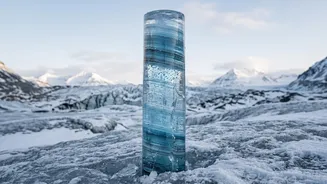
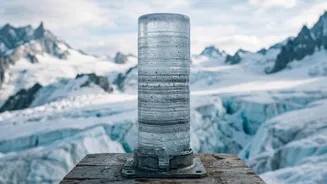
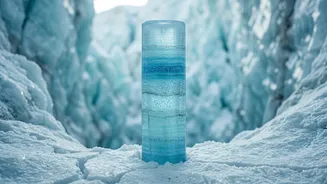
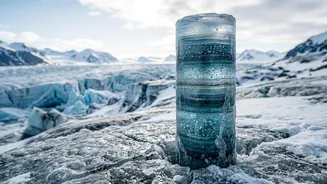
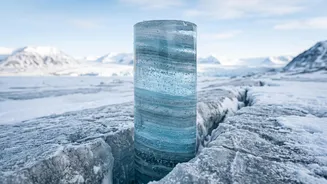
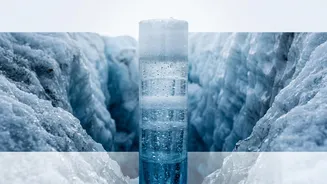
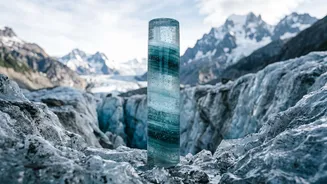
Imagine a library where each book is a year, and the pages are made of snow. That's essentially what an ice core is. In places like Antarctica and Greenland, snow that falls each year gets buried and compressed by the next year's snowfall. Over thousands
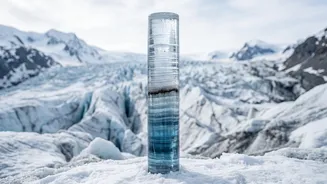
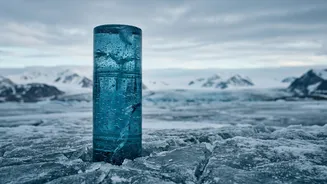
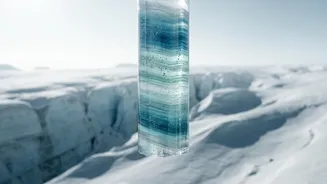
of years, this pressure turns the deep layers of snow into solid ice, creating a vertical timeline that can stretch back hundreds of thousands, and in some cases, even millions of years. Scientists drill deep into these ice sheets to extract cylinders of ice, some several kilometres long. Each layer of this ice is a snapshot of the year it formed, preserving clues about the environment. By analysing these layers, from the top (most recent) to the bottom (oldest), researchers can read the story of Earth's climate history chapter by chapter.
Reading Ancient Thermometers
One of the most crucial pieces of information locked in ice cores is a record of past temperatures. Scientists figure this out by analysing the water molecules that make up the ice itself. Specifically, they look at the ratio of different types of oxygen and hydrogen atoms, called stable isotopes. The relative amount of these heavy and light isotopes in the frozen water is directly related to the air temperature when the snow first fell. This allows scientists to reconstruct a reliable temperature record for a specific location, showing the planet's natural rhythm of cooling and warming through glacial periods (ice ages) and warmer interglacial periods. These natural cycles, driven by factors like changes in Earth's orbit, provide a crucial baseline of natural climate variability.
Breathing Prehistoric Air
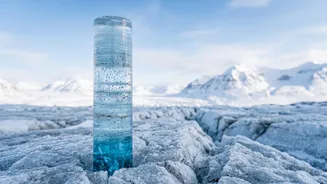
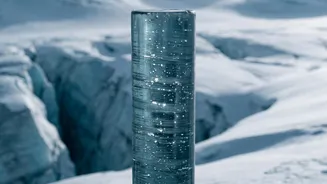
Perhaps the most compelling evidence from ice cores comes from tiny bubbles of air trapped within the ice. As snow is compressed, it traps small pockets of the surrounding atmosphere, which are then preserved as the snow turns to ice. These bubbles are time capsules, providing a direct sample of Earth's past atmosphere. By carefully extracting and analysing this ancient air, scientists can measure the concentration of greenhouse gases like carbon dioxide (CO2) and methane. This gives us a direct record of atmospheric composition, not an estimate. When scientists plot this data over time, they see a clear and consistent pattern: during past natural cycles, temperature and CO2 levels have risen and fallen together.
The Unmistakable Human Fingerprint
This is where the story pivots from natural history to human impact. The ice core record, which extends back at least 800,000 years, shows that for millennia, atmospheric CO2 concentrations naturally fluctuated between about 170 and 300 parts per million (ppm). In all that time, the level never broke above 300 ppm. Then, around the start of the Industrial Revolution, something changes dramatically. The CO2 levels recorded in the upper, more recent layers of ice—and confirmed by modern atmospheric measurements—begin to skyrocket. Today's concentration is far above any level seen in the entire 800,000-year ice core record. Furthermore, by analysing the specific type of carbon (isotopes) in the atmosphere, scientists can confirm that this new CO2 comes from burning old carbon sources—fossil fuels. The ice core data provides the long-term context that shows that while climate does change naturally, the speed and magnitude of the recent spike in greenhouse gases are unprecedented and not part of any known natural cycle.