


A Glimpse into the Cosmic Dawn
For decades, the story of the early universe seemed straightforward. According to our best models of cosmology, the first galaxies to form after the Big Bang were small, chaotic, and clumpy. They were the building blocks, not the finished product. Scientists
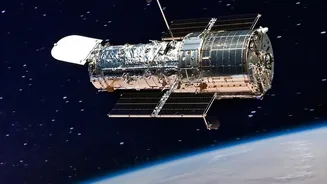
believed these primordial systems would take billions of years to pull themselves together, slowly organizing into the grand, structured spirals like our own Milky Way. This was the dominant theory, shaping our picture of cosmic history and the evolution of everything we see. Powerful tools like the James Webb Space Telescope (JWST) were designed to peer back into this era, known as the cosmic dawn, to witness this gradual assembly firsthand. Astronomers were expecting to find galaxies in their infancy.
Finding Teenagers in the Nursery
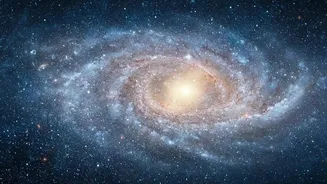
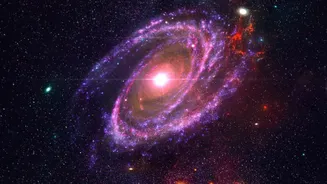
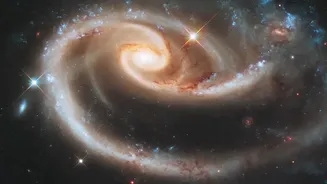
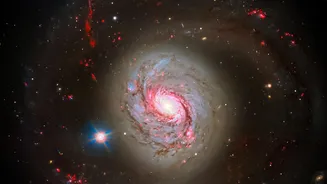
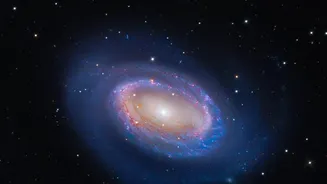
What JWST found has been described as 'bananas' by some astronomers. Instead of chaotic infant galaxies, recent deep-field images have revealed systems that look shockingly mature. Some galaxies, seen as they were when the universe was less than a billion years old, already display well-defined structures. Astronomers are identifying features like dense, spinning nuclear discs of new stars, which are typically found in much more evolved galaxies. One such galaxy, CEERS-4031, seen when the cosmos was just a third of its current age, already has a settled, orderly core that is busy forging stars. Finding such a developed structure so early is like looking into a nursery and finding fully-grown teenagers.
Why This Changes the Textbooks
This discovery presents a major challenge to the standard story of galaxy formation. The problem is time. Complex structures like spiral arms and central discs are thought to form through gradual gravitational processes that unfold over billions of years. Finding them in the universe's first billion years suggests one of two things: either those processes are much faster and more efficient than our models predict, or galaxies can form through different pathways altogether. It forces a fundamental rethink of the timeline of cosmic evolution. Current simulations of galaxy formation struggle to produce such massive and organized galaxies so quickly, a discrepancy that has scientists racing back to their models.
The Power of New Eyes
These revelations are a testament to the power of the James Webb Space Telescope. Its ability to capture faint, infrared light from the most distant corners of the cosmos allows us to see the universe in a way that was previously impossible. Before JWST, our view of the early universe was much fuzzier. Now, we are getting a high-definition look at the first chapters of cosmic history, and with that clarity comes a wave of new, complex questions. While these findings might seem to 'break' cosmology, they are actually doing what science does best: using new data to refine our understanding and push the boundaries of knowledge. These 'impossible' galaxies don't mean our theories are completely wrong, but they do show that the universe is more creative and complex than we ever imagined.
Rethinking Cosmic Growth
The conversation among astrophysicists is now buzzing with new ideas. Some theories suggest that the growth of supermassive black holes at the center of galaxies may play a more crucial and rapid role in organizing them than previously thought. Other research is exploring whether the conditions in the very early universe were more conducive to rapid star formation and structural development. For example, recent discoveries of 'Little Red Dots' — potentially the cores of nascent galaxies — suggest these objects may be the building blocks of the more mature systems we are now seeing. This is not just a single discovery but a whole new field of inquiry opening up, forcing scientists to question long-held assumptions about everything from star formation to the influence of dark matter in the early cosmos.