






First Sighting and Tracking
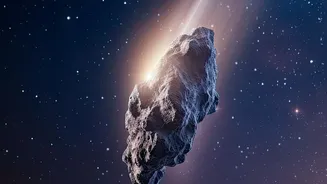
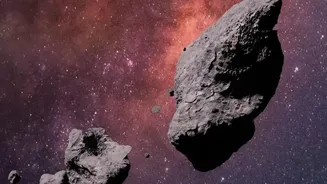
The process begins with discovery. Telescopes around the world, both on the ground and in space, are constantly scanning the skies for near-Earth objects (NEOs). Systems like NASA's Planetary Defense Coordination Office coordinate these efforts to find,
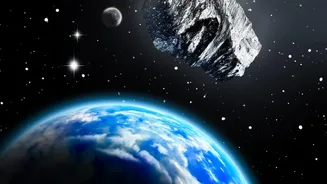
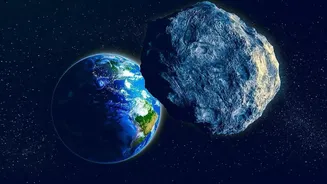
track, and characterize asteroids and comets. Once a new object is spotted, astronomers take multiple observations to calculate its orbit. This initial path is often uncertain, creating a range of possible trajectories. Continuous monitoring is crucial; the more data they gather over time, the more precisely they can predict the asteroid's future path, including whether it will intersect with Earth's atmosphere.
Size, Speed, and Entry Angle
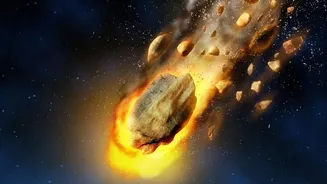
Whether an asteroid survives its fiery plunge depends on three critical factors: its size, speed, and angle of entry. Generally, space rocks smaller than about 25 meters (or 82 feet) will most likely burn up completely, creating a brilliant meteor or fireball. Larger objects have a much better chance of surviving. Speed is another crucial variable. Asteroids can enter the atmosphere at hypervelocities, often between 15 and 30 kilometers per second. This incredible speed causes the air in front of the object to compress and heat up intensely, leading to ablation—the process of the rock vaporizing layer by layer. Finally, the entry angle matters immensely. A shallow angle gives the atmosphere more time to slow the object down, while a steep, direct entry means it punches deeper into the denser lower atmosphere with more energy, increasing its chances of reaching the ground.
What Is It Made Of?
Not all asteroids are created equal. Their composition plays a huge role in their ability to withstand the intense heat and pressure of atmospheric entry. An asteroid's makeup can range from a loose collection of rubble and ice (like a comet) to a dense chunk of rock or solid iron. A dense, metallic asteroid is far more likely to survive the journey than a porous, rocky one of the same size. Scientists can get a good idea of an asteroid's composition using spectroscopy. By analyzing the light reflected off the asteroid's surface, they can identify the signatures of different minerals and elements, such as silicates, carbon, or metals like iron and nickel. This information is a key input for their models.
Running the Simulations
With data on the asteroid's orbit, size, speed, angle, and composition, scientists turn to powerful computer models. Organizations like NASA and the ESA run complex simulations to forecast what will happen. These models simulate the extreme forces the asteroid will experience, predicting its deceleration, how much mass it will lose to ablation, and whether it will break apart. The simulations can estimate the altitude of a potential airburst, like the one over Chelyabinsk, Russia, in 2013, and the energy it might release. For larger objects, these models help planetary defense experts understand the potential for ground impact and what would be required to mitigate the threat, a field of study that includes missions like NASA's DART (Double Asteroid Redirection Test).
Meteor vs. Meteorite
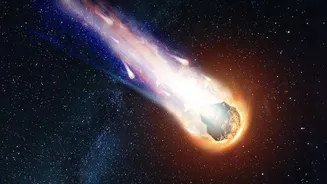
The final outcome determines what we call the object. A meteoroid is a small body in space. When it enters Earth's atmosphere and vaporizes, the streak of light it creates is called a meteor, or a shooting star. Most end their journey this way. However, if any part of the object survives the fiery descent and lands on the surface, it is then called a meteorite. Scientists study these recovered fragments to learn more about the composition of their parent asteroids, which helps refine the models used to predict the fate of future incoming objects.