






The Overlooked Powerhouse
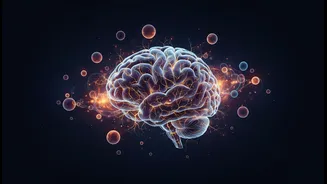
Tucked away at the back of the skull, the cerebellum makes up only 10% of the brain's volume but contains over half of all its neurons. For centuries, it was primarily associated with motor functions—coordinating movement, balance, and posture. If you
can play the guitar or ride a bike, you have your cerebellum to thank for fine-tuning those actions. However, recent research has unveiled its much deeper involvement in cognitive and emotional processes, including language, attention, and abstract thought. This expanded role means that understanding its intricate wiring is more critical than ever. In fact, some studies show that a surprising 80% of the cerebellum is dedicated to these non-motor functions, effectively acting as a quality control unit for the rest of the brain.
The Challenge of a Billion-Piece Puzzle
Mapping the brain is one of the greatest scientific challenges of our time. The human brain contains roughly 86 billion neurons, forming trillions of connections, or synapses. The wiring diagram is still largely unknown. Trying to trace these pathways is like trying to map a city with billions of intersecting streets, all of which are microscopic and constantly changing. Traditional methods of studying brain tissue involve slicing it thinly and observing it under a microscope, but this is painstakingly slow and provides only a static, incomplete picture. Furthermore, new cell types and connections are constantly being discovered. Recent studies have revealed that Purkinje cells, the main output neurons of the cerebellum, have a much more complex structure in humans than previously believed, challenging long-held assumptions. Manually incorporating these new discoveries into our existing models is a monumental task.
Enter Machine Learning: A Pattern-Finding Engine
This is where machine learning (ML) comes in. At its core, ML, and specifically a subset called neural networks, is designed to do what humans find difficult: recognize patterns in massive, complex datasets. Inspired by the structure of the brain itself, artificial neural networks (ANNs) consist of layers of interconnected nodes that process information. By training these networks on vast amounts of data—such as high-resolution brain scans or genetic information—they learn to identify relationships and make predictions. For neuroscientists, this is like having a superpower. An ML model can sift through the data from thousands of neurons, identify previously unseen patterns of activity, and generate a functional model of how a circuit works in a fraction of the time it would take a human researcher.
Modeling the New and the Unknown
When neuroscientists discover a new type of cerebellar cell or a novel connection, the immediate questions are: What does it do? And how does it fit into the larger network? Machine learning provides a powerful framework for answering this. Researchers can feed data about the new cell's activity into an ML model. The model can then simulate how the entire network behaves with and without this new component, helping to predict its function. For example, recent findings have overturned assumptions about how Purkinje cells and deeper cerebellar cells interact, showing their relationship is less predictable than thought. ML models are ideal for exploring these complex, non-linear dynamics. Spiking neural networks, which more closely mimic biological neurons, can simulate brain activity with millisecond precision, allowing scientists to test hypotheses about how these circuits support learning and movement.
From Digital Models to Medical Breakthroughs
The ultimate goal of modeling the cerebellum is to understand and treat the disorders linked to its dysfunction. Conditions like ataxia (a lack of voluntary muscle control), tremors, and even some aspects of autism spectrum disorder and schizophrenia have been linked to the cerebellum. By creating highly accurate, predictive models, scientists can simulate what goes wrong in these conditions. They can test how a specific genetic mutation might alter a cell network's function or how a potential drug might restore normal activity—all within a computer. This computational approach, where an AI model of the cerebellum acts as a 'digital twin', can vastly accelerate the search for new therapies, making the development of treatments faster, cheaper, and more targeted.