



Not Sand, But Soot
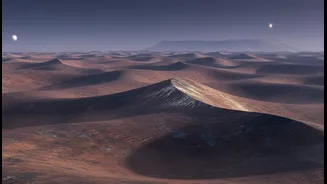
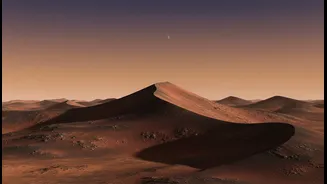
When we think of dunes, whether in the Sahara or at a local beach, we think of sand—tiny grains of silicate rock. But the dunes on Titan, which are gigantic by Earthly standards at up to 100 metres high and hundreds of kilometres long, are made of something
far more exotic. They are not composed of rock or metal, but of solid organic particles. Data from NASA's Cassini mission revealed that this 'sand' is actually made of hydrocarbon grains that precipitate out of Titan's thick, hazy atmosphere. Think less of sand and more of a fine, dark soot or something akin to coffee grounds that has slowly settled over millennia to form colossal dunes.
An Alien Chemical Factory
So where do these organic particles come from? Titan’s atmosphere is a chemical factory. It is composed mostly of nitrogen, like Earth's, but also contains about 5% methane. High in the atmosphere, harsh ultraviolet light from the Sun and energetic particles from Saturn's magnetic field break apart the methane and nitrogen molecules. These fragments then recombine to form a complex soup of organic compounds. These heavy, carbon-rich particles, sometimes called 'tholins', slowly drift down through the smoggy orange sky. Over immense timescales, this constant drizzle of hydrocarbon dust has accumulated on the surface, creating a layer of organic sediment that is then sculpted by the moon's winds.
Explaining the Metallic Look
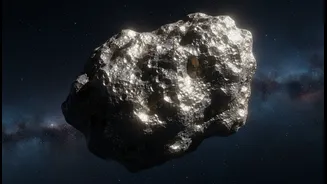
The 'metallic' appearance isn’t a true metallic shine, like polished chrome. Instead, it’s an optical effect caused by the unique properties of the dunes and Titan’s bizarre environment. The hydrocarbon grains are very dark and do not reflect much light. When viewed by radar instruments, like those on the Cassini spacecraft, these dark, smooth, and fine-grained materials appear distinct against the landscape. The way they scatter light in Titan’s dense, hazy atmosphere contributes to a dark, slightly reflective quality that scientists have described as metallic. While not shiny metal, the description captures the strange, otherworldly visual of these dark waves of organic material.
A Similar Sight on Mars
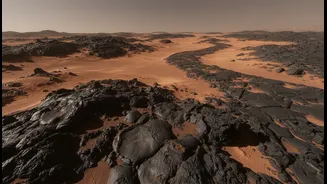
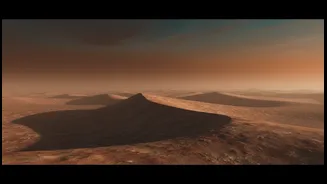
Interestingly, Titan isn't the only other world with dunes that have a metallic appearance. The European Space Agency’s Mars Express orbiter has captured images of vast dune fields inside Kaiser Crater on Mars that also appear to shimmer. In this case, the cause is different. The Martian dunes are made of dark, volcanic basaltic sand. Their metallic sheen is thought to be caused by a combination of their dark mineral composition and bright frost deposits that form on their slopes, creating a striking contrast that can look like polished metal from orbit. It serves as a reminder that similar appearances in space can arise from very different geological and atmospheric processes.
Why These Dunes Matter
Studying Titan's dunes is crucial for understanding its climate and geology. These dunes are the largest single surface reservoir of carbon in Titan's complex organic chemistry. Unraveling their composition and how they are formed provides vital clues about the moon’s methane cycle, which is comparable in some ways to Earth's water cycle. Laboratory experiments have shown that complex molecules, including some precursors to the building blocks of life, can be formed in conditions mimicking Titan's surface. This makes Titan a key destination in the search for environments that could potentially harbor life, or at least the chemical precursors to it.