




The Silent Threat Above
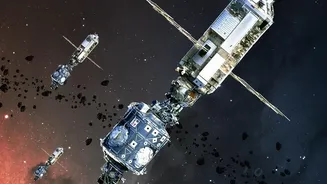
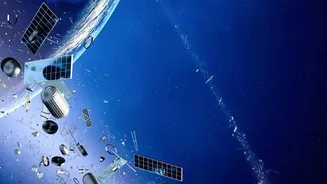
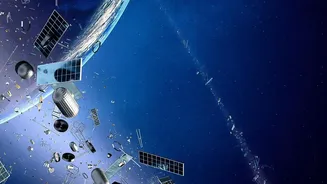
Imagine a highway with millions of uncontrolled, speeding projectiles. That is the reality in low-Earth orbit, the region of space up to 2,000 kilometres above us. It is home to thousands of active satellites crucial for communication, navigation, weather
forecasting, and national security. But it is also cluttered with over 1.2 million pieces of space debris larger than a centimetre—defunct satellites, spent rocket stages, and fragments from past collisions—all hurtling at speeds of up to 28,000 kilometres per hour. At these velocities, even a paint chip can cause significant damage. A larger piece could completely destroy a multi-crore satellite, creating even more debris and triggering a catastrophic chain reaction. In 2025 alone, ISRO had to perform 20 collision avoidance manoeuvres to safeguard its orbital assets, demonstrating the growing severity of the problem.
The Old Way of Dodging Bullets
Until now, protecting satellites has been a manual, labour-intensive process. Ground-based radar stations and telescopes track known pieces of debris. When a potential collision is flagged, teams of engineers analyse the risk, calculate a new trajectory, and manually send commands to the satellite to fire its thrusters and move out of the way. This process is slow, often requiring hours or days of lead time, and consumes precious fuel, which in turn shortens the operational lifespan of the satellite. As the number of satellites and debris proliferates, this reactive, human-in-the-loop system is becoming unsustainable. The sheer volume of data and the need for split-second decisions are pushing human capabilities to their limit.
AI Enters the Orbit
This is where Artificial Intelligence comes in. The new generation of satellite protection systems moves the decision-making from the ground into space. By integrating AI algorithms directly with a satellite’s propulsion system, the spacecraft can gain autonomy. These AI models can process vast amounts of data from various sensors in real-time, predict the trajectory of debris with greater accuracy, and make independent decisions to execute small, precise, and highly fuel-efficient thruster burns to avoid a collision. This automated process is faster, more accurate, and eliminates the reliance on constant ground control. Indian startups and research institutions are at the forefront of developing these intelligent systems.
India's Push for Autonomous Satellites
The Indian Space Research Organisation (ISRO), in collaboration with academic institutions like IIIT-Delhi, is developing AI-powered platforms for Space Situational Awareness (SSA). The goal is to automate everything from threat detection to collision avoidance. Private Indian firms are also making significant strides. Startups like Manastu Space and Bellatrix Aerospace are developing advanced, efficient propulsion systems, including green propellants and Hall-effect thrusters, which are ideal for the precise manoeuvres required for autonomous collision avoidance. Digantara, another space tech startup, is specifically developing algorithms to enable satellites to communicate with each other and autonomously negotiate their paths to prevent collisions, aiming to make it a reality within the next five years. These efforts are part of a broader national strategy, supported by IN-SPACe, to foster self-reliance and position India as a leader in space technology.
Securing India's Future in Space
The development of AI-powered thrusters is more than just a safety measure; it's a strategic imperative. For India, which has 22 active satellites and is rapidly expanding its presence in space, protecting these assets is critical. Autonomous satellites are more resilient, have longer operational lives, and are less expensive to operate. This technology also offers a significant commercial advantage. As global mega-constellations launched by companies like SpaceX add thousands of new satellites, the demand for effective, automated traffic management systems will soar. By developing these capabilities indigenously, India not only secures its own assets but also positions its space industry to capture a significant share of the future global space economy, offering these advanced systems and services to other nations.