



A Panoramic View of the Cosmos
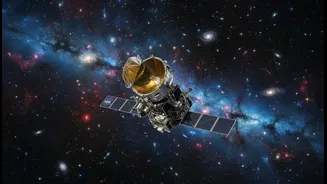
Imagine the Hubble Space Telescope's sharp vision, but with a field of view 100 to 200 times wider. That's the game-changing capability of the Nancy Grace Roman Space Telescope. While Hubble and the James Webb Space Telescope (JWST) are designed to peer
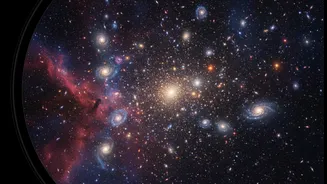
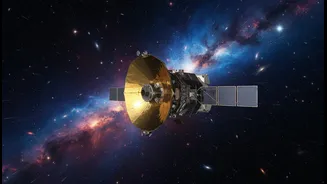
deeply into small patches of sky like cosmic microscopes, Roman is a panoramic survey machine. Its primary instrument, the 300-megapixel Wide Field Instrument (WFI), will capture vast mosaics of the universe with the same resolution as Hubble. This ability to map huge swaths of the sky quickly and efficiently will allow astronomers to conduct unprecedented cosmic surveys, creating enormous datasets that will fuel discovery for decades to come. The telescope is named for Nancy Grace Roman, NASA's first chief of astronomy and the driving force behind the Hubble, who championed space-based observatories.
Hunting for Dark Energy
One of Roman’s primary goals is to confront one of the most profound puzzles in physics: dark energy. This mysterious force is causing the expansion of the universe to accelerate, but scientists don't know what it is or how it works. Roman will tackle this question by mapping the structure and expansion of the universe over billions of years with incredible precision. It will do this in two key ways. First, it will conduct a vast survey of galaxies, measuring their distribution and how their light has been distorted by the gravity of intervening dark matter—a technique called weak gravitational lensing. Second, it will detect thousands of Type Ia supernovae, a specific kind of stellar explosion whose predictable brightness allows them to be used as 'standard candles' to measure cosmic distances and the rate of universal expansion. These combined observations will create the most detailed 3D maps of the universe ever made, allowing scientists to trace the history of cosmic expansion and test theories about the nature of dark energy.
A Galactic Census of Alien Worlds
Beyond cosmology, Roman is set to revolutionize the search for planets outside our solar system. While NASA's Kepler and TESS missions have found thousands of exoplanets by watching for the dimming of a star as a planet passes in front (the transit method), Roman will primarily use a different technique called gravitational microlensing. This method detects planets by observing how their gravity, and that of their host star, bends and magnifies the light from a more distant, unrelated star that passes behind them. Microlensing is particularly sensitive to planets farther from their stars—in orbits similar to Earth's or Jupiter's—and even to 'rogue' planets that wander the galaxy without a host star. Because these events are rare and brief, Roman’s wide, continuous stare toward the dense star fields at the center of the Milky Way is ideal. Astronomers predict Roman could discover thousands of new worlds this way, providing a statistical census of planets across a much wider range of masses and orbits than ever before. It is also expected to find around 100,000 planets via the transit method.
Final Preparations for Launch
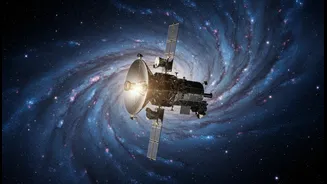
The mission, once known as WFIRST, is now in the home stretch. The massive telescope has been fully assembled and tested at NASA's Goddard Space Flight Center. In June 2026, it arrived at the Kennedy Space Center in Florida to begin final preparations for its journey to space. Technicians are now undertaking inspections and functional tests before the observatory is fueled, encapsulated in its protective fairing, and mounted atop a SpaceX Falcon Heavy rocket. With a targeted launch date of August 30, 2026, Roman is set to travel to the second Sun-Earth Lagrange point (L2), about 1.5 million kilometers from Earth, where it will join the JWST in a stable orbit with an unobstructed view of the cosmos.