







India’s Unblinking Eye on the Sun
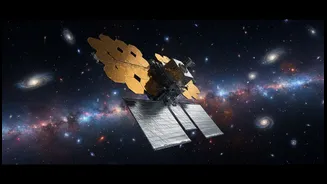
Launched by the Indian Space Research Organisation (ISRO), Aditya-L1 is the nation's first dedicated solar observatory. It's strategically positioned in a halo orbit at Lagrange Point 1 (L1), a spot in space where the gravitational pulls of the Earth
and Sun balance out. This unique vantage point allows the spacecraft to watch the sun continuously, without Earth ever blocking its view. Armed with seven sophisticated instruments, Aditya-L1’s job is to simultaneously observe the sun's surface (photosphere), the layer above it (chromosphere), and its enigmatic outer atmosphere (the corona). This comprehensive approach is already yielding a treasure trove of data that is crucial for understanding solar dynamics and space weather.
The Mystery of the Sizzling Atmosphere
One of the longest-standing puzzles in astrophysics is the coronal heating problem. The sun's visible surface simmers at about 5,500°C, but its outer atmosphere, the corona, is hundreds of times hotter, reaching over a million degrees Celsius. This defies the basic logic that things should get cooler as you move away from a heat source. Aditya-L1's observations are providing fresh evidence that challenges previous theories. New findings suggest that the extreme heat isn't primarily caused by waves bubbling up from the surface. Instead, the data points towards the constant, violent interaction of tangled magnetic fields in the atmosphere as the main engine for heating the corona. These localised magnetic reconnections are now believed to be the primary mechanism replenishing the immense energy in the sun's atmosphere.
A New Look at Solar Flares
The Solar Ultraviolet Imaging Telescope (SUIT) payload on Aditya-L1 has achieved a remarkable feat: capturing the first-ever detailed images of a solar flare 'kernel' in the near-ultraviolet (NUV) range. This part of the light spectrum, largely unobserved in detail before, provides a new window into the sun's explosive activity. During a powerful X-class solar flare, SUIT detected localised brightening in the sun's lower atmosphere. Crucially, these bright spots corresponded directly with a temperature spike in the plasma of the corona above. This confirms a direct link between the energy deposited during a flare and the heating of the atmosphere, validating long-held theories but with unprecedented clarity that will reshape our understanding of these massive solar explosions.
When Solar Storms Collide
Aditya-L1 is not just a passive observer; it's an active participant in a global network of spacecraft. In a landmark study of a major solar storm, Aditya-L1 joined forces with six other US satellites to witness something extraordinary. They observed two Coronal Mass Ejections (CMEs)—giant clouds of solar plasma and magnetic fields—colliding in space. The collision was so forceful that the magnetic field lines within one of the storms snapped and reconnected, a process that made the storm's impact on Earth much stronger than expected. Thanks to Aditya-L1's precise magnetic field measurements, scientists were able to map this giant reconnection zone for the first time, an area spanning 1.3 million kilometres.
Why These Strange Findings Matter
Unravelling these solar mysteries is about more than just academic curiosity. The same processes that make the sun look strange—magnetic reconnections, solar flares, and CMEs—are the drivers of space weather. These solar storms can have a profound impact on Earth, disrupting satellite communications, damaging power grids, and posing risks to navigation systems and even astronauts. By providing a more complete picture of how energy flows through the sun and erupts into space, Aditya-L1's findings are a crucial step toward building a more robust space weather prediction system for India and the world.