
The New 'Goldilocks' Factor
For decades, the search for habitable exoplanets focused on the 'Goldilocks zone'—the orbital range where it's not too hot and not too cold for liquid water to exist on a planet's surface. But scientists now realise this is only part of the story. A planet can
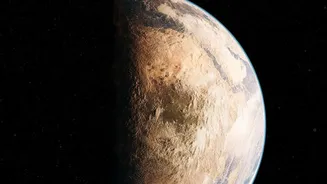
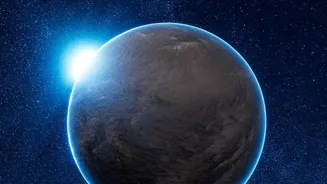
be at the perfect distance from its star, but if it can't retain a substantial atmosphere, any potential for life evaporates into space. An atmosphere provides crucial insulation, shields the surface from harmful radiation, and creates the pressure needed for liquid water. Without it, a promising rocky world is just a barren rock. This has shifted the focus of major astronomical inquiry: it's no longer just about where planets are, but whether they can sustain the conditions necessary for life over billions of years.
The Persistent Threat of Atmospheric Escape
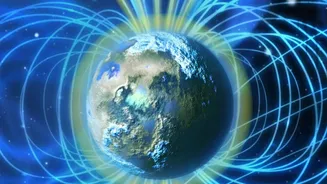
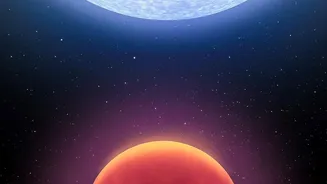
Planets face a constant battle to keep their gaseous envelopes. The primary culprit in atmospheric loss is the planet's own star. Stars, especially younger and more volatile ones like red dwarfs, bombard their planets with high-energy radiation and a constant stream of charged particles known as stellar wind. This onslaught can literally strip an atmosphere away over millions of years, a process called atmospheric escape. A planet's own properties, like its size, mass, and whether it has a protective magnetic field, determine its ability to resist this stripping. By studying this process, scientists can create a new set of rules to determine which planets are the best candidates in the search for life, filtering out those that are in the right place but have long since lost their atmospheric shield.
Webb’s Mission: Reading the Void
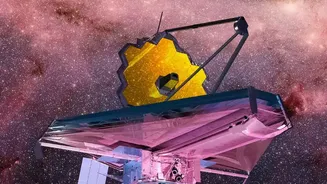
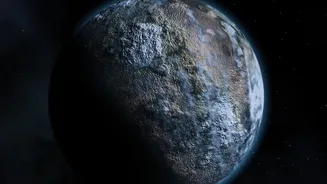
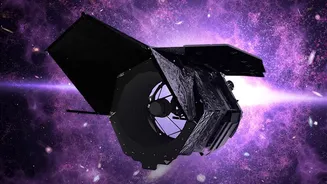
This is where the James Webb Space Telescope's unparalleled power comes in. Its incredible sensitivity allows it to do what no other telescope could: analyse the incredibly faint signals from exoplanet atmospheres. The primary method is transmission spectroscopy. When a planet passes in front of its star, a tiny fraction of the starlight filters through its atmosphere. By capturing this light, Webb's spectrographs can spread it into a rainbow, revealing the chemical fingerprints of gases like carbon dioxide, methane, or water vapor. Crucially, it can also show if there's no atmosphere at all. Observing a bare rock registers a flat, featureless spectrum, providing conclusive evidence of atmospheric loss. This capability moves the conversation from theoretical models to direct observation.
Case Study: The Hellish World of 55 Cancri e
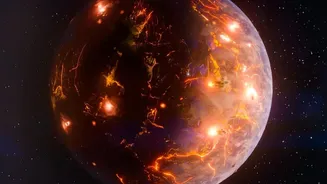
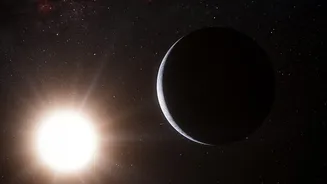
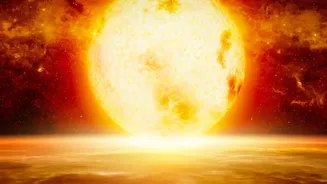
A key target for this research has been 55 Cancri e, a 'super-Earth' orbiting extremely close to its star. While far too hot to be habitable, its extreme environment makes it a perfect laboratory for studying atmosphere and surface interactions. Initially, scientists were unsure if it was a bare magma ocean or if it had a thick atmosphere. Webb's observations provided the best evidence to date that it does have an atmosphere, likely rich in carbon dioxide or carbon monoxide, which is constantly being replenished by a bubbling ocean of magma on the surface. The planet’s temperature was cooler than expected for a bare rock, suggesting an atmosphere is redistributing heat. Studying how a planet like 55 Cancri e holds onto any atmosphere under such intense stellar radiation provides vital clues for understanding more temperate worlds.
Redefining the Search for Another Earth
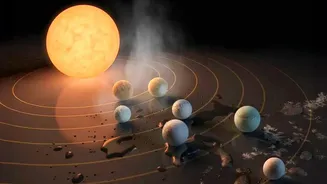
The work being done by JWST is fundamentally refining the search for life. By studying planets like those in the TRAPPIST-1 system—some of which are in the habitable zone—astronomers are trying to determine which have managed to retain their atmospheres despite orbiting a very active red dwarf star. Early results have shown some of the inner planets are likely bare rock. This process of elimination is critical. It allows scientists to focus precious telescope time on the most promising candidates: rocky worlds of the right size, in the right orbit, that have also proven they can hold onto a life-sustaining atmosphere over cosmic timescales. This new filter, made possible by Webb, is sharpening our search for worlds that could truly be called Earth-like.