



The Promise of a Distant Ocean
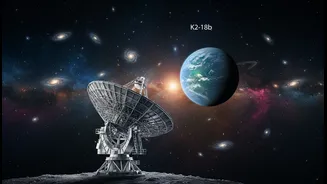
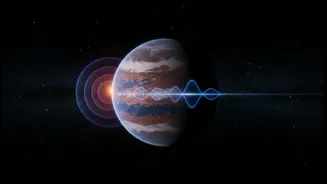
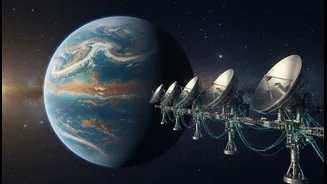
Lying 124 light-years away, K2-18b captured global attention as a potential 'Hycean' world—a planet larger than Earth possibly covered by a vast ocean under a hydrogen-rich atmosphere. Orbiting within its star's habitable zone, it presents the tantalizing
possibility of conditions suitable for life. Initial observations with the James Webb Space Telescope (JWST) added fuel to this fire, detecting key carbon-bearing molecules like methane and carbon dioxide. This discovery marked K2-18b as a prime target in the search for life, suggesting an environment far more complex than a simple barren rock.
A Whiff of Controversy
The real excitement began when analysis of JWST's infrared data hinted at the presence of dimethyl sulfide (DMS), a gas that on Earth is overwhelmingly produced by marine life. The potential detection of such a potent biosignature sparked a firestorm of discussion. If confirmed, it would be the most significant evidence for extraterrestrial life ever found. However, science demands rigorous proof. The initial signal was weak, and the claim was met with healthy scepticism from the scientific community, who noted that extraordinary claims require extraordinary evidence. The stage was set for a deeper investigation to settle the matter.
Doubts Creep In
As other scientists began to scrutinize the same JWST data, the case for DMS on K2-18b began to weaken. Several independent research groups re-analyzed the observations using different methods and pipelines. Their conclusions were sobering: the evidence for dimethyl sulfide was not statistically significant. These studies suggested that the faint signal could be an artifact of data processing or that it was simply too weak to be distinguished from background noise. This doesn't mean there is no life, but it does mean the specific evidence for DMS has not held up under the intense scrutiny required for such a profound discovery. The scientific process, in effect, was working as designed—testing and re-testing bold claims.
A Different Kind of Search
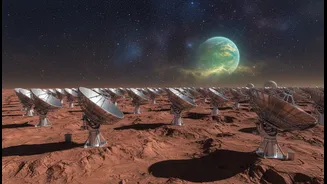
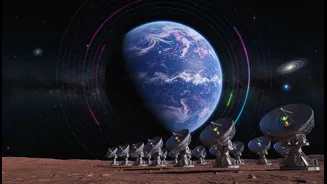
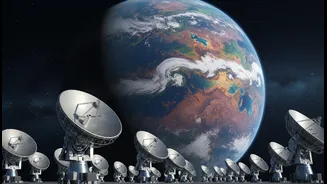
While the debate over chemical biosignatures continues, a completely different search was recently conducted, one that directly addresses the 'advanced radio survey' portion of the story. A team of astronomers used two of the world's most powerful radio telescope arrays—the Very Large Array (VLA) in the US and MeerKAT in South Africa—to listen for technosignatures from K2-18b. This wasn't a search for the chemical byproducts of simple organisms, but for signals indicative of intelligent, technology-using life, such as artificial radio transmissions.
The Sound of Silence, and Success
The massive radio survey of K2-18b found no evidence of alien technology. After filtering through millions of potential signals, none could be convincingly attributed to an extraterrestrial civilization. However, the project was still a resounding success. The team developed and demonstrated a powerful new software pipeline capable of analyzing vast amounts of data with unprecedented speed and accuracy. This advanced method is crucial for filtering out the immense radio frequency interference from Earth-based sources and focusing on the faint, Doppler-shifted signals that might one day come from a distant world. In essence, they built a much better needle-in-a-haystack detector for future searches.