




Beyond 'Just Right' Temperatures
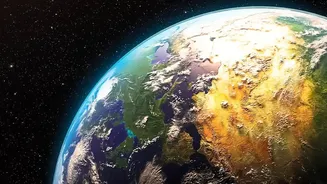
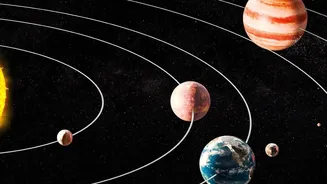
The concept of the habitable zone is a simple, useful starting point in our cosmic search for life. It defines the orbital range where a planet could potentially have liquid water on its surface, a key ingredient for life as we know it. Earth sits comfortably
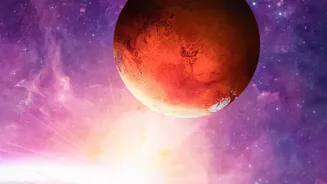
in our sun's habitable zone. Mars and Venus are also on the edges of this zone, yet one is a frozen desert and the other a scorching greenhouse. This immediately tells us that location isn't everything. Even our own Moon orbits within this zone but is devoid of life. It has become clear to scientists that simply being in the right neighbourhood doesn't guarantee a warm, wet, life-bearing world. A planet's address is important, but its intrinsic properties are what truly determine its potential for life.
A Planet Needs a Protective Shield
One of the most critical, yet often overlooked, factors is a planetary magnetic field. Generated by a molten, rotating core, this invisible shield deflects harmful stellar winds and cosmic rays. Without a strong magnetosphere, a star's energetic particles can strip away a planet's atmosphere over millions of years, which is what scientists believe happened to Mars. This process would not only cause the planet to lose its air but also allow its water to escape into space. Earth’s strong magnetic field is a key reason our atmosphere and oceans have remained stable for billions of years, protecting the surface from radiation that could be damaging to life. Therefore, a planet in the perfect location without this protective bubble would likely be a barren, irradiated wasteland.
The Right Kind of Star
Not all stars are created equal when it comes to hosting life. The type of star a planet orbits matters immensely. For instance, red dwarfs are the most common type of star in our galaxy. Their habitable zones are very close to the star, which sounds promising, but these stars are often volatile. They can unleash powerful flares with intense X-ray and ultraviolet radiation, which could sterilise a nearby planet and strip its atmosphere. On the other hand, stars much larger and hotter than our Sun have very short lifespans, possibly not long enough for complex life to evolve. Scientists now think that stars like our own G-type, or slightly smaller and cooler K-type stars, offer the best combination of stability and longevity—the true 'sweet spot' for habitable worlds.
The Air We Could Breathe
An atmosphere does more than just provide air to breathe; it acts as an insulating blanket, trapping heat and stabilising surface temperatures. Without it, a planet would experience extreme temperature swings between day and night. The atmosphere's composition is also crucial. It must contain the right mix of gases. Too much of a greenhouse gas like carbon dioxide can lead to a runaway greenhouse effect, like on Venus, making the surface hot enough to melt lead. Too little, and the planet can't stay warm enough for liquid water. The atmosphere also shields the surface from harmful radiation. A planet's size and gravity play a huge role here; it must be massive enough to hold onto its atmosphere over billions of years.
A Geologically Active World
It might seem counterintuitive, but a geologically active planet with volcanoes and plate tectonics may be vital for long-term habitability. Plate tectonics, the movement of a planet's crustal plates, is a uniquely terrestrial feature in our solar system. This process plays a critical role in regulating Earth’s climate over geological timescales by recycling carbon. Volcanoes release carbon dioxide from the planet's interior into the atmosphere, warming the planet, while geological weathering processes draw it back down, cooling it. This global thermostat has kept Earth's climate relatively stable for eons. This nutrient and element cycling, driven by a dynamic interior, could be a fundamental difference between a planet that is merely a sterile rock and one that is teeming with life.