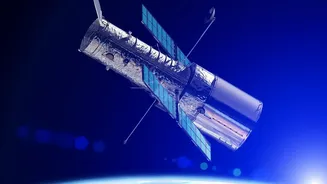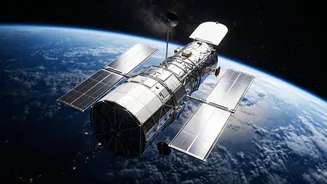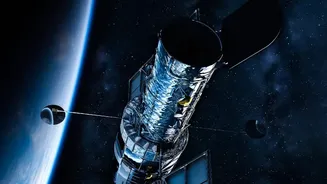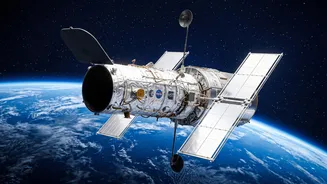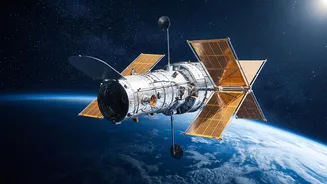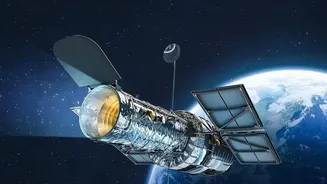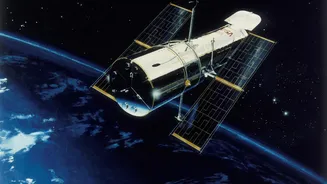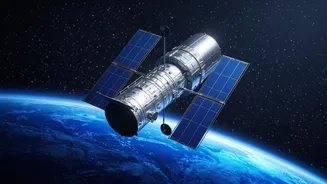




For over 35 years, the Hubble Space Telescope has been humanity's eye on the cosmos. But its legendary journey is nearing an end as its orbit slowly decays. Now, NASA is turning to the commercial space industry for a lifeline.
A Race Against Gravity
The Hubble Space Telescope
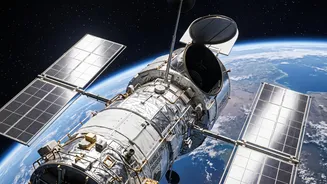
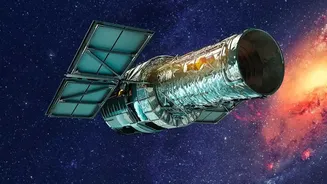
is slowly falling. Launched in 1990 to an altitude of over 600 kilometers, atmospheric drag has since pulled it down to roughly 470 kilometers. With no propulsion system of its own, Hubble is on a countdown to re-enter Earth's atmosphere, an event NASA projects could happen between 2033 and 2034. This gradual descent threatens not just a beloved scientific instrument but also a unique capability; its ability to see in ultraviolet and visible light is not replicated by newer observatories like the James Webb Space Telescope. To prevent an uncontrolled, fiery end and preserve its scientific contributions, NASA has set a deadline: any rescue mission must happen by 2032.
From Study to Solicitation
This isn't the first time NASA has looked for help. In 2022, the agency signed an unfunded agreement with SpaceX to study the feasibility of using a Dragon spacecraft, as part of the private Polaris Program, to reboost the telescope. After reviewing those and other concepts from an initial inquiry, NASA initially decided not to pursue a commercial reboost. However, the agency's stance has evolved. In late October 2026, NASA's Goddard Space Flight Center issued a formal Request for Information (RFI), officially inviting the entire commercial space sector to submit ideas by a November 30 deadline. This is not a contract but a crucial market research step to see what's possible, who can do it, and at what cost.
The Three Options on the Table
The RFI outlines three potential paths for commercial partners. The most ambitious option is to capture Hubble and boost it to a more stable orbit of at least 600 kilometers, which could add 15 to 25 years to its operational life. The second option involves a servicing mission to upgrade Hubble's components, potentially improving its performance and resilience for its remaining years. The final option is a managed exit: a mission to safely guide the massive telescope to a controlled re-entry over a remote ocean area, ensuring debris does not pose a risk. NASA has made it clear that any mission must not harm the telescope.
A New Business Model for Space
NASA's call for proposals signals a major shift from the era of the Space Shuttle, which performed five successful servicing missions on Hubble. With the shuttle fleet retired, the agency is now leaning on the burgeoning commercial space industry to provide end-to-end solutions. A successful company would be responsible for the launch vehicle, the servicing spacecraft, and all mission operations—including a crew, if the proposal calls for one. This creates a landmark opportunity for companies in the in-space servicing market, like Astroscale and Momentus who have previously proposed robotic solutions, and potentially SpaceX with its crewed Dragon capsule. The recent failed attempt to rescue the Swift observatory by a commercial partner highlights the significant risks and technical challenges involved in such missions.