

The Cosmic Shadow Play
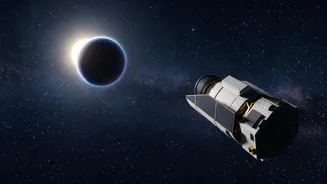
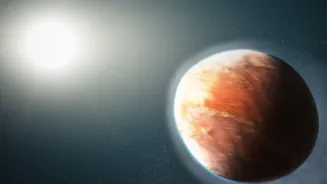
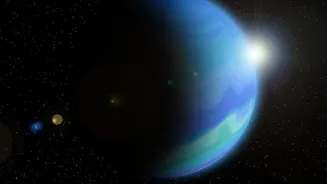
To study a planet hundreds of light-years away, astronomers need a bit of cosmic luck: the planet must pass directly between us and its star. This event is called a transit. As the planet crosses its star, it causes a tiny, almost imperceptible dip in the star's
brightness. But for scientists, the real magic happens at the planet's edge. For a brief moment, a sliver of starlight filters through the planet’s atmosphere before continuing its journey to our telescopes. That starlight carries an imprint of the air it just passed through, holding the secrets of its composition. This technique, known as transit spectroscopy, is the primary method for peering into the atmospheres of these remote worlds.
Decoding a Barcode of Light
The light that reaches a telescope after passing through an exoplanet's atmosphere isn't the same as the light that left the star. Just as a prism splits white light into a rainbow, a device called a spectrograph breaks down the starlight into its constituent wavelengths. When scientists examine this spectrum, they find that certain colours, or wavelengths, are missing. They appear as dark bands, creating a unique pattern that looks like a barcode. Each gas—whether it's water vapour, carbon dioxide, or methane—absorbs light at very specific, predictable wavelengths. So, by identifying which 'bars' are missing from the starlight's spectrum, astronomers can definitively identify the gases present in that distant planet's atmosphere.
Carbon Dioxide: The Planetary Foundation
One of the first molecules scientists look for is carbon dioxide (CO2). On its own, CO2 is not a sign of life. After all, the atmospheres of Mars and Venus are overwhelmingly composed of it. However, its presence is a crucial first clue. Detecting a significant amount of CO2, as the James Webb Space Telescope (JWST) has done on several exoplanets, confirms that the planet has a substantial atmosphere. This is a foundational requirement for habitability as we understand it. It tells scientists that the planet is not a barren rock but a dynamic world with atmospheric processes, making it a compelling target for a more detailed search for other, more exciting molecules.
Methane: A Telltale Tremor
The detection of methane (CH4) is where things get truly interesting. On Earth, the vast majority of methane in the atmosphere is produced by living organisms, from microbes in wetlands to cows. Methane is chemically fragile; in an atmosphere, it gets broken down relatively quickly by sunlight. This means that if a telescope detects a constant and significant amount of methane, something must be actively and continuously replenishing it. While non-biological sources like certain types of volcanoes can produce methane, they are often less prolific than a thriving biosphere. Finding methane immediately raises the question: could a biological source be responsible?
The Duet: A Sign of Disequilibrium
The most powerful biosignature isn't just one gas, but a specific combination: finding both methane and carbon dioxide in the same atmosphere. This points to a state of chemical disequilibrium. Methane (a reducing gas) and the byproducts of processes involving CO2, like oxygen, are chemically reactive and shouldn't coexist in large quantities for long without something constantly producing them. Finding them together suggests that the planet's atmosphere is being actively maintained in a state that is far from its natural chemical balance. On Earth, it is life that creates and sustains this disequilibrium. The absence of other gases, like carbon monoxide, which would be expected from volcanic activity, further strengthens the case that the source could be biological.
The Tools for the Hunt
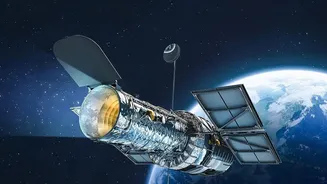
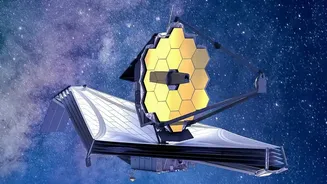
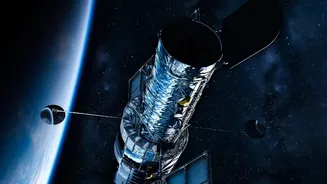
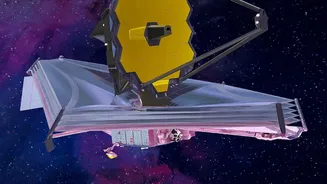
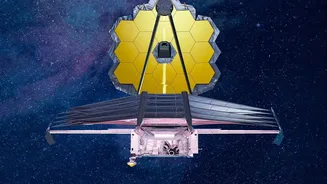
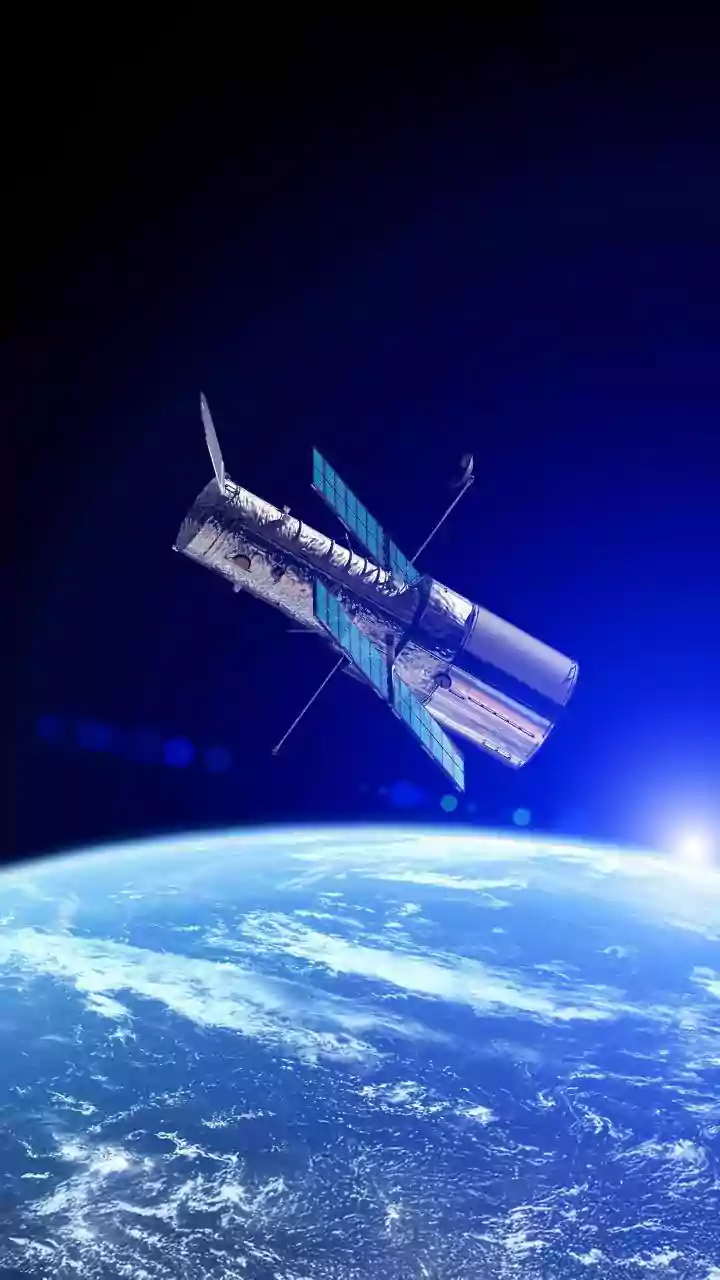
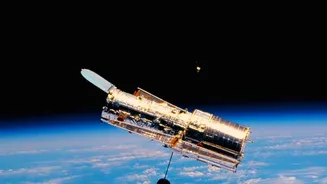
This entire field has been revolutionised by the James Webb Space Telescope. Its incredible sensitivity and access to infrared wavelengths, where molecules like methane and carbon dioxide leave their clearest fingerprints, have turned theoretical ideas into observational reality. Webb has already successfully detected both gases in the atmospheres of planets like K2-18 b, a 'sub-Neptune' world that has become a prime target for study. While space-based telescopes like Webb and Hubble are essential because they operate above Earth's own distorting atmosphere, new ground-based techniques are also being developed to expand the search. This combination of powerful tools is rapidly accelerating our ability to catalogue the atmospheric ingredients of worlds near and far.