





A Galaxy's Sudden Glow-Up
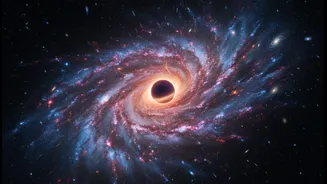
Deep in the Virgo constellation, some 300 million light-years from Earth, the galaxy SDSS1335+0728 was, until recently, just another quiet corner of the cosmos. For decades, it showed no signs of unusual activity. Then, in late 2019, astronomers at the Zwicky
Transient Facility in California noticed something remarkable: the galaxy’s core was suddenly, and dramatically, getting brighter. This wasn't a fleeting flicker; the galaxy began to radiate much more light in the ultraviolet, optical, and infrared wavelengths, and the glow has continued to intensify for more than four years. More recently, it even started emitting X-rays, signaling a truly massive change was underway.
What Does 'Waking Up' Mean?
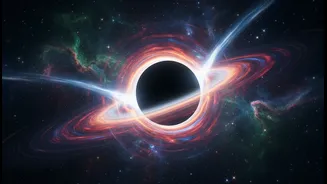
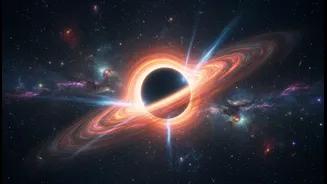
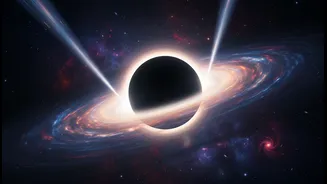
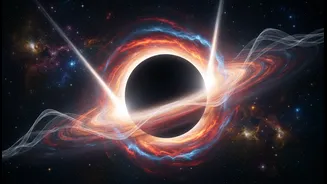
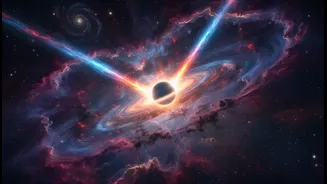
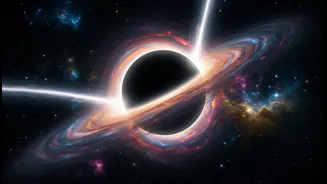
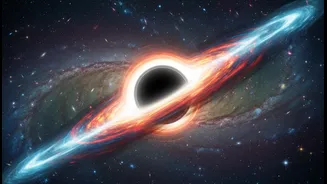
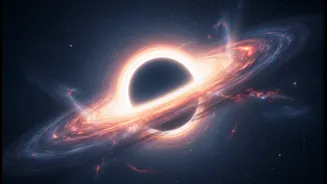
At the heart of most large galaxies, including our own Milky Way, lies a supermassive black hole. Most of these are 'sleeping' or dormant, meaning they aren't actively swallowing large amounts of matter. What astronomers believe they are seeing with SDSS1335+0728 is the black hole transitioning into an Active Galactic Nucleus, or AGN. This happens when a black hole begins to feast on a massive supply of gas and dust from its surroundings. As this material gets pulled in, it forms a fiercely hot, bright disc around the black hole, unleashing an enormous amount of energy that can outshine all the stars in the galaxy combined.
Cosmic Detectives on the Case
Catching a black hole in the act of turning on is an unprecedented achievement. Normally, astronomers only see the before (a quiet galaxy) or the after (a fully-fledged AGN). When the initial alert came through, scientists first considered more common cosmic events. Could it be a supernova, a star exploding? Or maybe a tidal disruption event (TDE), where a star gets shredded after wandering too close to the black hole? Both were ruled out. Supernovae and TDEs cause galaxies to light up for a few dozen or maybe a few hundred days. SDSS1335+0728 has been brightening for years, making this explanation unlikely. This long-lasting, ongoing transformation points toward the birth of an AGN.
A New Window into the Universe
This discovery, made possible by combining data from an array of ground-based and space telescopes like the European Southern Observatory's Very Large Telescope (VLT), is monumental. It provides the first-ever real-time look at the activation process of a supermassive black hole. Observing this 'awakening' as it unfolds gives scientists an invaluable opportunity to understand the lifecycle of these cosmic engines and their profound impact on their host galaxies. These events may be a fundamental, though rarely seen, part of how galaxies evolve over billions of years. While a particularly strange and long-lasting tidal disruption event hasn't been completely ruled out, the leading theory is that we are witnessing the birth of a new active nucleus.