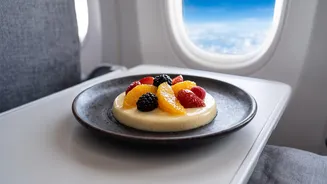








Ever wondered why that dessert you craved tastes a little dull at 35,000 feet? It’s not your imagination, and it’s not entirely the chef’s fault. The environment inside an airplane cabin actively changes how your body perceives flavour.
The Real Reason Your Food Tastes Different
The common complaint
about airline food being bland is a travel trope for a reason, but the cause is more complex than the catering. The main culprits are the cabin pressure and the extremely low humidity. At cruising altitude, the cabin is pressurised to the equivalent of being on a mountain top at 6,000 to 8,000 feet. This lower pressure, combined with humidity levels often below 12%—drier than most deserts—creates an environment that directly attacks your senses. This one-two punch is primarily responsible for altering your perception of taste and smell long before the meal cart reaches your row.
The Science of a Dulled Palate
The key to this sensory shift lies in how we experience flavour, which is about 80% reliant on our sense of smell. The desert-dry air in the cabin dries out your nasal passages and mucous membranes, which are crucial for detecting the aroma molecules that define a food's flavour. Without a fully functioning sense of smell, your ability to taste is significantly hampered. It’s a similar effect to eating with a bad cold. At the same time, the low pressure reduces the oxygen saturation in your blood, which can make your taste and smell receptors less effective. This combination means that both sweet and salty tastes are the first to fade.
The Thirty Percent Claim Explained
The headline-grabbing figure comes from a landmark study commissioned by German airline Lufthansa in 2010. Researchers at the Fraunhofer Institute for Building Physics used a simulated aircraft cabin to test how the in-flight environment affects taste. Their findings were stark: sensitivity to sweet and salty flavours dropped by as much as 30 percent. Interestingly, other tastes were far more stable. The perception of sour, bitter, and spicy notes remained largely unchanged, explaining why more acidic or spicy dishes often taste better in the air.
It’s Not Just the Air, It’s the Noise
A third, often overlooked factor contributes to your muted palate: the constant drone of the jet engines. The background noise in a typical cabin hovers around 85 decibels, similar to city traffic. Research from Cornell and Oxford universities found that this loud, continuous noise can suppress the brain's ability to register sweet tastes. However, the same noise has the opposite effect on 'umami', the fifth basic taste associated with savoury and brothy flavours. This sensory enhancement makes umami-rich foods like tomatoes, mushrooms, and aged cheese more appealing at altitude, which is why tomato juice is a famously popular drink on flights.
How Airlines Are Fighting Back with Food Science
Airlines and their catering partners are well aware of this science and design their menus accordingly. To compensate for passengers' dulled palates, chefs deliberately increase seasoning and focus on ingredients that withstand the sensory assault of flying. They lean heavily on umami-rich components like tomato concentrate, parmesan cheese, and soy sauce to ensure dishes have a flavourful punch. Spices and acidic ingredients are also used to 'wake up' the palate. Many airlines test their recipes in pressurised cabin simulators to ensure they taste as intended not on the ground, but at 35,000 feet.