

The Standard Cosmic Recipe
For a long time, the prevailing theory of our universe's evolution has been the Lambda-CDM model. Think of it as the standard recipe for the cosmos. It begins with the Big Bang, followed by a rapid period of expansion. This model successfully explains
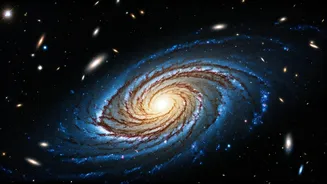
many cosmic phenomena we observe today, from the faint afterglow of creation, known as the cosmic microwave background, to the large-scale structure of galaxies. The ingredients are simple: a bit of ordinary matter (everything you can see and touch), a healthy portion of invisible dark matter providing gravitational scaffolding, and a mysterious dark energy causing the universe's expansion to accelerate. In this story, the first galaxies start small and grow slowly over billions of years, merging and accumulating mass like cosmic snowballs rolling downhill.
The Unexpected New Evidence
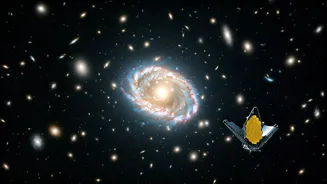
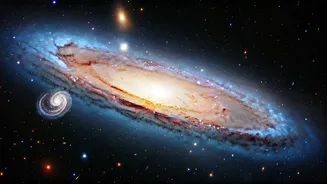
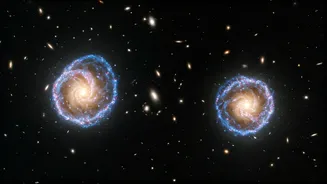
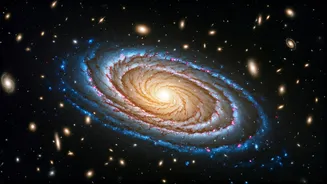
Then came the James Webb Space Telescope (JWST). With its powerful infrared vision, it has peered deeper into cosmic history than ever before, and what it's finding is shaking things up. Recent observations have revealed galaxies in the very early universe—some existing less than a billion years after the Big Bang—that are far more massive, complex, and mature than they should be. Some appear to be rich in heavy elements, or 'metals' in astronomical terms, which are byproducts of multiple generations of stars that shouldn't have had time to live and die yet. Other discoveries show multiple large galaxies merging in tightly packed clusters, a process previously thought to happen much later in cosmic history. It’s like finding a fully grown adult in a nursery, and astronomers are scrambling to explain it.
What Could This Mean?
These findings don’t necessarily mean our entire understanding of the universe is wrong, but they do suggest the standard recipe needs some serious tweaking. Scientists are now exploring a range of fascinating possibilities. One idea is that star formation in the early universe was far more efficient and 'bursty' than models predicted, allowing galaxies to bulk up quickly. Another possibility is that the seeds of supermassive black holes existed much earlier than thought, acting as gravitational anchors that accelerated galaxy growth. Some of the most puzzling new objects, dubbed 'little red dots', could be a completely new type of cosmic object powered by these rapidly growing black holes. More radical ideas question the very nature of dark matter or suggest dark energy might behave differently over time. Each possibility opens up exciting new avenues for research.
A Crisis or a Breakthrough?
Headlines might scream about a 'crisis in cosmology', but for the scientists involved, this is the opposite of a disaster—it's a breakthrough. The Lambda-CDM model has been incredibly successful, but it always had known tensions and gaps, such as the 'Hubble Tension,' a disagreement on the universe's expansion rate. The new JWST data isn't breaking cosmology; it's providing the crucial clues needed to build a more complete model. Every time a new observation challenges a long-held theory, it’s an opportunity to learn something profound. This is the scientific method in action: a cycle of prediction, observation, and refinement. These 'impossible' galaxies aren't a sign that we're lost, but rather a sign that we are on the verge of a deeper understanding of our cosmic origins.