




How Webb Hunts for Alien Air
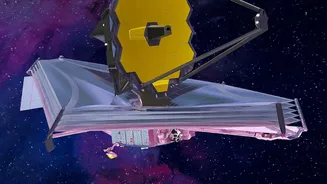
Before we dive into the findings, it helps to understand how the Webb telescope even 'sees' an atmosphere hundreds of light-years away. The primary method is called transit spectroscopy. As an exoplanet passes in front of its host star from our perspective,
a tiny fraction of the starlight filters through the planet's atmosphere, if one exists. Webb's incredibly sensitive instruments capture this light and break it down into a spectrum, like a rainbow. Different molecules in the atmosphere absorb specific colours, or wavelengths, of light, leaving behind a unique chemical 'fingerprint'. By analysing which colours are missing, scientists can identify gases like methane, carbon dioxide, and the holy grail for habitability hunters: water vapour.
The Challenge of Rocky Worlds
Finding atmospheres on rocky planets is significantly harder than on their gas giant cousins. A planet like Jupiter is huge and its thick, puffy atmosphere blocks a lot of starlight, creating a strong signal. Rocky planets are much smaller, and their potential atmospheres are far thinner and denser. This means the signal Webb has to detect is astonishingly faint. Furthermore, many rocky exoplanets orbit very close to their stars, where intense radiation and stellar winds can strip away any atmosphere, leaving behind a bare rock. For years, many scientists believed it might be impossible for these planets to retain any significant gaseous envelope. The initial JWST programs have focused on the most observable targets, but a definitive, undisputed detection of an atmosphere around a rocky planet has remained elusive until very recently, with many results showing hints that are difficult to confirm.
A Steamy, Hellish Breakthrough
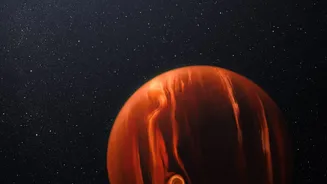
Webb's recent observations have begun to change the game, providing the strongest evidence yet for atmospheres on rocky worlds—though they are far from Earth-like. One major target is 55 Cancri e, a 'super-Earth' twice our planet's size that orbits so close to its star its surface is likely a molten ocean of magma. In May 2024, Webb data indicated the planet's dayside was cooler than expected for a bare rock, suggesting a substantial atmosphere was redistributing heat. More recent findings from July 2026 suggest this atmosphere is not what models predicted. Instead of being rich in carbon dioxide, it appears to be a dynamic, hydrogen-rich atmosphere that is constantly being replenished by gases bubbling out of the magma ocean below. This suggests that even on the most hellish lava worlds, a planet's interior can sustain a significant atmosphere.
Water Vapor, but Not Water Worlds
The headline-grabbing discovery is often water. In early 2024, observations from the Hubble telescope (often a pathfinder for Webb) detected water vapour in the atmosphere of a small exoplanet, GJ 9827d. This was a landmark discovery, pushing closer to characterising Earth-like worlds. However, a critical distinction must be made. Detecting water vapour is not the same as finding a water world with oceans and rain. GJ 9827d, for example, is as hot as Venus, and if its atmosphere is predominantly water, it would be an inhospitable, steamy world. Scientists are often left with two possibilities: is it a small amount of water in a larger, hydrogen-rich atmosphere (making it a 'mini-Neptune'), or a world that has lost its initial hydrogen and is left with a denser, water-heavy atmosphere? Webb's power is helping to solve these puzzles, but the context is crucial: the presence of water vapour is just one ingredient for habitability.
The Road Ahead: Patience and Precision
The first few years of Webb's mission have shown that characterising rocky planets is a complex, incremental process. In some cases, like with the famous TRAPPIST-1 system, Webb has so far failed to find any stable, thick atmosphere around its Earth-sized worlds. In others, a potential water signal could be coming from cool spots on the star itself rather than the planet. These challenges don't represent failure; they are part of the scientific process. They push astronomers to refine their models and develop new observation strategies. One exciting prospect is finding water in the planet-forming disks themselves, which Webb has done in the PDS 70 system, confirming that the building blocks for wet, rocky worlds exist right where they are needed. Ultimately, the search is shifting towards cooler, more stable planets that are more likely to have retained their atmospheres over billions of years.