
Watching for Planetary Shadows
One of the most successful ways to find a planet is the transit method. Imagine watching a bright lamp from across a field. If a moth flies in front of it, you'll see a tiny, brief dip in the light. Astronomers do the same, but with stars. Telescopes
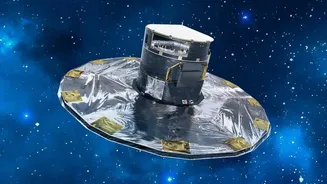
like NASA's Transiting Exoplanet Survey Satellite (TESS) stare at stars, looking for a minuscule, periodic dimming. This 'transit' indicates that a planet is passing in front of its star from our point of view. The amount the star dims tells scientists how big the planet is, and the time between transits reveals how long it takes the planet to orbit its star. Most of the thousands of confirmed exoplanets have been found this way.
Detecting a Celestial Wobble
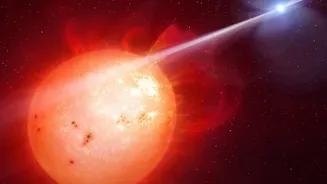
Planets don't just orbit stars; they also exert a tiny gravitational pull on them. This causes the star to 'wobble' slightly as the planet circles it. This technique, known as the radial velocity method, doesn't look at the planet at all, but rather the subtle movements of its parent star. As the star wobbles, moving slightly toward and away from Earth, the light we receive from it shifts. When it moves toward us, its light waves get compressed and shift toward the blue end of the spectrum; as it moves away, they stretch out and become redder. By measuring these tiny shifts in the star's light, called Doppler shifts, astronomers can deduce the presence of an unseen planet and even estimate its minimum mass.
Analyzing the Air of Another World
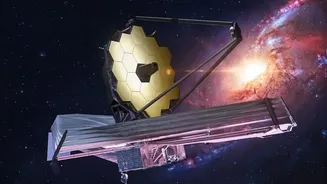
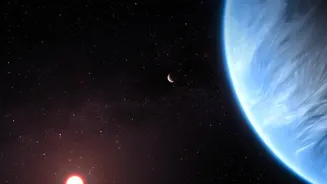
Simply finding a planet is just the beginning. The next big question is: what is it like? To answer this, scientists use a technique called spectroscopy. When a planet with an atmosphere transits its star, the starlight passes through that atmosphere before reaching our telescopes. Different gases in the atmosphere absorb specific colours, or wavelengths, of light. This leaves a unique 'barcode' of missing light in the star's spectrum. By analyzing this barcode, astronomers can identify the chemical ingredients of the planet's atmosphere, such as water vapor, methane, or carbon dioxide. The James Webb Space Telescope (JWST) excels at this, giving us an unprecedented look at the air on worlds light-years away.
Taking a Direct Picture
The most challenging but perhaps most rewarding method is direct imaging—literally taking a picture of an exoplanet. This is incredibly difficult because planets are extremely faint compared to the blinding glare of their host stars. It's like trying to spot a firefly next to a powerful searchlight. To overcome this, astronomers use advanced instruments called coronagraphs, which are like a sophisticated hand that blocks the star's bright light, allowing the faint glow of an orbiting planet to be seen. While only a small number of exoplanets have been directly imaged so far, these pictures provide invaluable information. Recent successes with the JWST have pushed this technique forward, capturing images of planets and the dusty disks they form in.