




The Robotic Vanguard
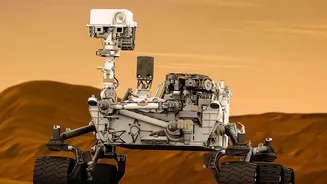
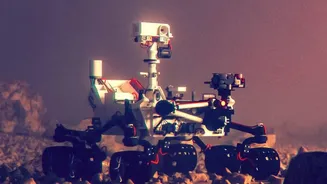
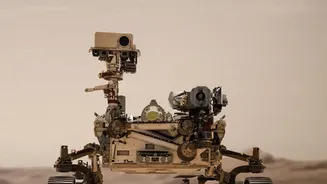
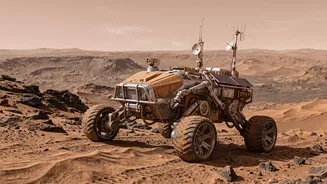
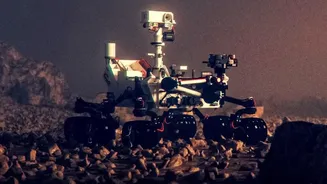
The argument for leading with robots is overwhelmingly practical. Robotic missions, like the Perseverance rover, are vastly cheaper than their crewed counterparts. Estimates suggest a human mission could cost hundreds of billions, even a trillion dollars,
while a robotic one costs a fraction of that. Robots don't need food, water, oxygen, or a return ticket, which dramatically reduces the weight and complexity of the spacecraft. They are immune to the life-threatening dangers of deep space, such as cosmic radiation and the physiological toll of microgravity. For decades, robotic orbiters, landers, and rovers have served as our indispensable eyes and ears on the Red Planet, mapping the surface, analysing the atmosphere, and scouting for resources like water ice that would be critical for future human explorers. They can operate for years, patiently gathering data in hostile environments, laying the scientific groundwork for the day humans might follow.
The Irreplaceable Human Element
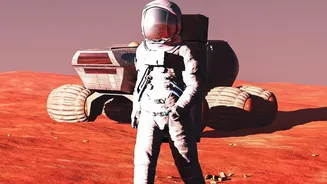
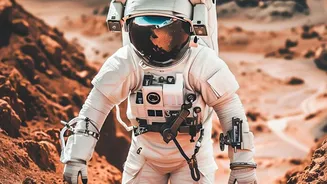
Despite the utility of robots, there remains a strong case for sending people. The key advantage is adaptability. While a rover moves at a crawl—NASA's Curiosity has a top speed of just 0.14 km/h—a human geologist can walk, climb, and react to their surroundings instantly. Astronauts possess intuition and an ability to make on-the-spot decisions that no remote-controlled robot can match. They can pivot an entire line of inquiry based on an unexpected discovery, like a strangely coloured rock, and perform complex tasks with a dexterity that current robotics cannot replicate. The scientific return can be exponentially greater. In just three days on the Moon, the Apollo 17 crew collected over 100 kg of samples and covered 35 kilometres; by contrast, the Curiosity rover has travelled less than 30 km in over a decade. For many, human exploration also carries a unique inspirational value that can galvanize public interest and drive innovation.
The Ultimate High-Stakes Mission
Sending humans to Mars is arguably the most difficult undertaking humanity has ever considered. The challenges are monumental. Astronauts on a mission that could last up to three years would be exposed to significant levels of galactic cosmic radiation, far outside the protection of Earth's magnetic field. This increases the long-term risk of cancer, cardiovascular disease, and damage to the central nervous system. The prolonged experience of microgravity during the six-month journey causes bone density loss and muscle atrophy. Beyond the physical toll, there are immense psychological pressures of being confined in a small spacecraft, isolated from Earth, where a conversation with Mission Control has a 20-minute time lag. Every system, from life support to the return vehicle, must function with near-perfect reliability, making the mission an engineering and financial challenge of the highest order.
A Partnership, Not a Rivalry
Ultimately, the 'robots vs. humans' debate presents a false choice. The future of Mars exploration isn't one or the other, but a sophisticated partnership between both. NASA's strategy reflects this, viewing robotic missions as essential precursors to eventual human landings. In this hybrid model, robots will continue to go first. They will perform high-risk tasks, survey landing zones, and even begin constructing habitats and producing resources like fuel and oxygen from the Martian atmosphere and soil. Advanced humanoid robots could one day work alongside astronauts, handling repetitive or dangerous jobs, extending their reach and enhancing safety. Humans would then arrive, equipped with unparalleled data and supported by a robotic infrastructure, ready to apply their unique skills of complex problem-solving and scientific discovery. This symbiotic approach leverages the strengths of each, mitigating the weaknesses.