


A Milestone Measured in Light
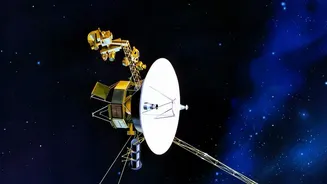
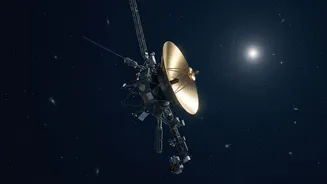
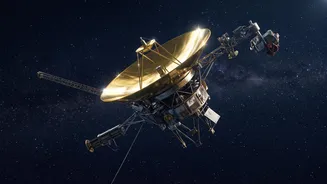
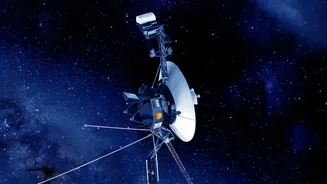
On November 18, 2026, Voyager 1 will be the first human-made object to be one light-day away from Earth. But what does that mean? A light-day is the immense distance light travels in 24 hours — approximately 25.9 billion kilometres. At this distance,
communication becomes a profound lesson in patience. A radio signal sent from NASA's Deep Space Network, travelling at the speed of light, will take a full day to reach the spacecraft. Any response from Voyager 1 will take another 24 hours to return, making a simple round-trip conversation a two-day affair. This milestone isn't just about distance; it's a tangible measure of our first steps into the galaxy.
A Journey That Redefined Exploration
Launched on September 5, 1977, Voyager 1's original mission was to study Jupiter and Saturn. It succeeded beyond all expectations, discovering new moons and rings, and revealing Jupiter's volcanic moon, Io. Following a crucial gravity-assist from Saturn in 1980, its trajectory flung it upwards, out of the plane of the planets and towards interstellar space. In 1990, it turned its camera one last time to capture the iconic 'Pale Blue Dot' image, a haunting portrait of Earth from six billion kilometres away. Then, on August 25, 2012, it officially crossed the heliopause — the boundary of our sun's influence — and entered the space between the stars.
Humanity's Farthest Ambassador
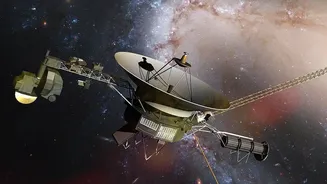
Attached to the side of Voyager 1 is a message in a bottle on a galactic scale: the Golden Record. This 12-inch, gold-plated copper disc contains sounds and images selected to portray the diversity of life and culture on Earth. Conceived by a committee led by famed astronomer Carl Sagan, the record includes greetings in 55 languages, music from various cultures, and natural sounds like wind, thunder, and birdsong. It also carries 116 images and scientific diagrams. While the chance of it being found by an alien civilisation is infinitesimal, the record serves as a time capsule of our world and a symbol of humanity's hope and curiosity.
Keeping a 70s Legend Alive
Keeping a spacecraft operational for nearly half a century, using technology from the 1970s, is a monumental feat of engineering. Voyager 1 is powered by a radioisotope thermoelectric generator, which converts heat from decaying plutonium into electricity. That power supply has dwindled significantly, from 470 watts at launch to around 215 watts today. To conserve energy, NASA engineers have been systematically shutting down instruments. Today, only two science instruments remain active, studying the interstellar environment. Despite recent communication glitches, the mission team has found clever ways to prolong the spacecraft's life, hoping to keep it transmitting data into the 2030s.