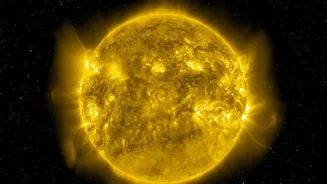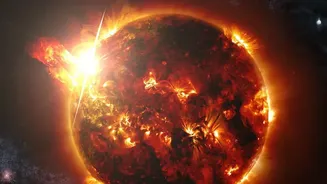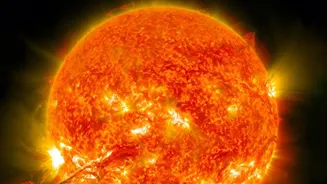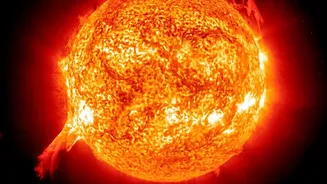



Fiery arches of glowing gas, many times the size of Earth, loop high above the Sun’s surface. These are solar prominences, one of the most beautiful and powerful solar phenomena. But what force allows them to defy the Sun's immense gravity?
A River of Plasma in the Sky
At its heart,
a solar prominence is an enormous, bright feature made of plasma that extends from the Sun's surface out into its hot outer atmosphere, the corona. This plasma is a hot gas of electrically charged hydrogen and helium. While they look intensely hot and bright against the dark backdrop of space, prominences are actually much cooler and denser than the surrounding corona. If you were to see one against the bright face of the Sun, it would appear as a dark, thread-like feature called a filament; they are two views of the same phenomenon. These structures can be colossal, stretching for hundreds of thousands of kilometres, and can remain stable for days or even months.
The Unseen Magnetic Skeleton
The key to understanding how these massive clouds of plasma are suspended is an invisible force: magnetism. The Sun's surface is a chaotic tangle of powerful magnetic fields. A prominence is formed and held in place by giant magnetic loops that are anchored to the Sun's surface, in a layer called the photosphere. Think of it like a massive, invisible scaffolding. This magnetic structure, often called a 'magnetic skeleton', provides the support needed to hold the dense plasma against the Sun's gravity and also insulates it from the incredibly hot corona. The plasma is essentially trapped, flowing along these tangled and twisted magnetic field lines.
Building the Fiery Arch
Scientists are still researching the exact mechanisms, but the formation begins when these magnetic fields rise from the Sun's interior. The fields are rooted in areas of opposite magnetic polarity on the Sun's surface. In the space above this dividing line, the magnetic field can form a dip or a channel where the cooler, denser plasma can collect. This material is either injected from the chromosphere below or condenses from hotter coronal plasma that gets trapped and cools down. Over the course of about a day, enough plasma accumulates within this magnetic cradle to form the visible structure we call a prominence.
The Trigger for an Eruption
While some prominences are stable for months, many become unstable and erupt, blasting vast quantities of plasma into space. An eruption happens when the magnetic structure holding the prominence becomes destabilized. This is often triggered by a process called 'magnetic reconnection'. Imagine the magnetic field lines as twisted rubber bands. If they become too twisted or are jostled by other magnetic fields, they can suddenly snap and reconfigure into a new, simpler shape. This violent event releases an enormous amount of stored magnetic energy in an instant. This explosive release of energy is what powers the eruption, launching the plasma outward at incredible speeds, sometimes over 1,000 kilometres per second.
From Prominence to Space Weather
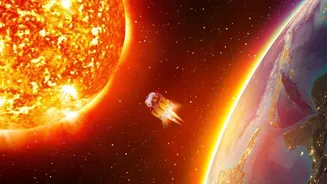
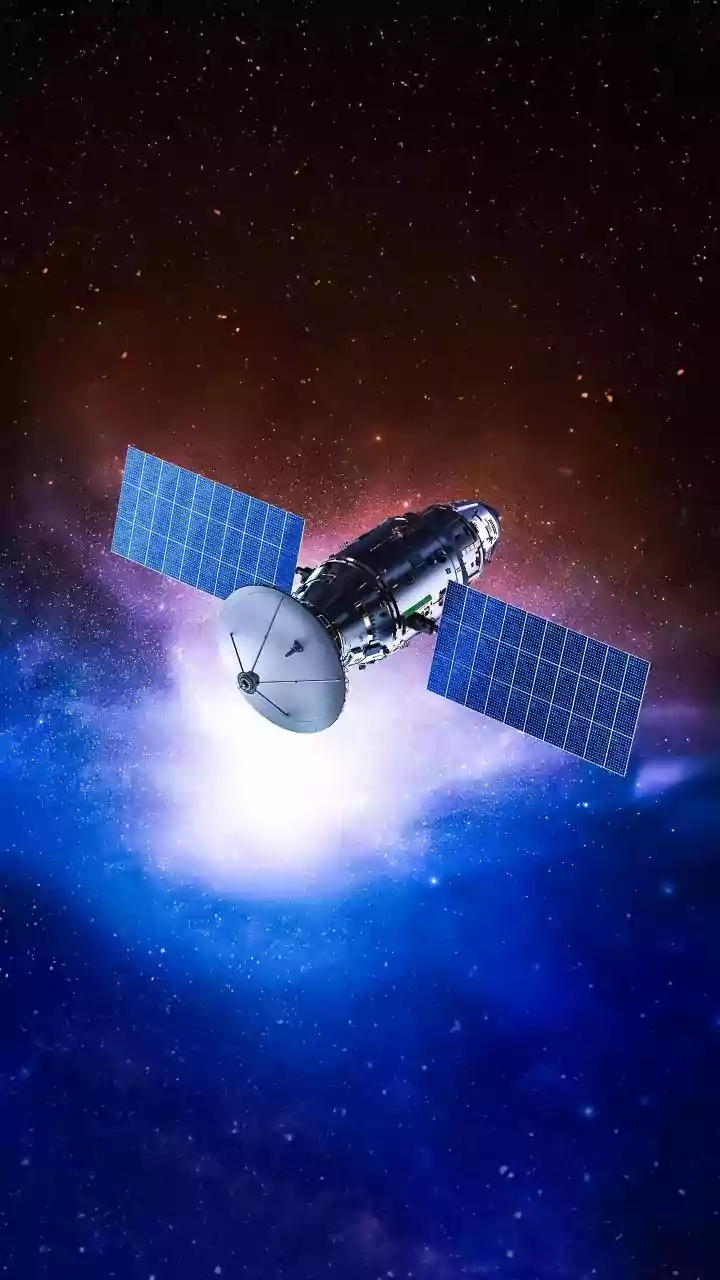
When a solar prominence erupts, it can give rise to a Coronal Mass Ejection (CME). A CME is a massive burst of solar wind and magnetic fields that hurtles into space. While many CMEs miss our planet, those directed towards Earth can have significant effects. They interact with Earth’s own magnetic field, causing geomagnetic storms. These storms are responsible for creating beautiful auroras but can also disrupt radio communications, damage satellites, and even threaten to overload electrical power grids on the ground. Understanding what makes a prominence rise and erupt is therefore not just a matter of cosmic curiosity; it's a crucial part of forecasting space weather and protecting our technology-dependent world.