

A Cosmic Disappearing Act
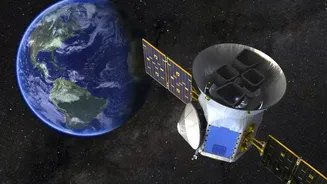
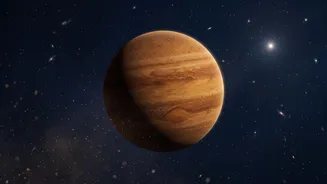
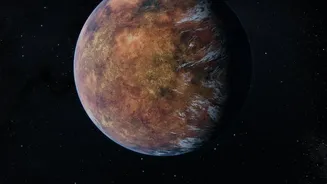
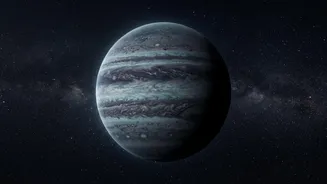
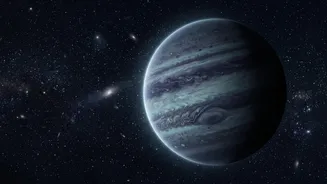
For seven years, from 2019 to early 2026, astronomers using NASA's Transiting Exoplanet Survey Satellite (TESS) kept a close eye on a planet named TOI-2535 b. Located about 1,000 light-years away, this world is a 'hot Jupiter'—a massive gas giant orbiting
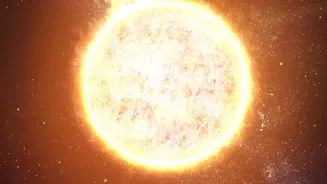
its star at a blistering pace, completing a full year in just over eight Earth days. TESS finds planets via the 'transit method', where it detects the faint, regular dip in a star's light as a planet passes in front of it from our point of view. For years, TOI-2535 b showed up like clockwork. Then, the clock started to get weird. The transits began arriving early or late by as much as six hours. The dips in light became shorter and shallower, and then, in March 2026, they stopped completely. The planet, from our perspective, had disappeared.
The Unseen Culprit
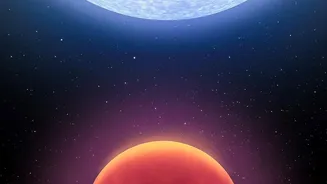
So, what happened? Did the planet get destroyed or wander off into deep space? The answer, scientists discovered, is far more elegant. TOI-2535 b didn't actually go anywhere. Its orbit was simply tilted out of our line of sight. Researchers concluded that the 'disappearing act' was caused by the gravitational pull of a second, previously unseen planet in the same system. This hidden neighbour, thought to be at least the mass of Saturn, is orbiting on a slightly different plane. Its persistent gravitational tug is pulling on TOI-2535 b, causing its orbit to wobble.
The Great Celestial Wobble
This phenomenon is known as orbital precession. You can picture it like a child's spinning top that starts to wobble as it slows down. The top is still spinning, but its axis of rotation is tracing a slow circle. Similarly, TOI-2535 b is still orbiting its star, but the entire plane of its orbit is slowly tilting due to the influence of its neighbour. For years, its orbital plane was perfectly aligned for us to see it transit its star. As the gravitational tugging continued, that plane tilted just enough that the planet no longer passes between its star and Earth. It now passes just above or below the star from our vantage point, rendering it invisible to the transit method. This is the first time astronomers have directly observed a planet's transits ceasing around a single star.
Why This Cosmic Mystery Matters
This discovery does more than just solve the case of the vanishing planet. It paints a vivid picture of how dynamic and interactive solar systems can be. 'We think of the universe as resembling clockwork, where everything is regular, but that's not true', said Samuel Yee of the University of California, Los Angeles, one of the researchers on the study. When multiple planets exist in a system, they constantly influence one another's orbits. The case of TOI-2535 b is one of the most extreme examples of this interaction ever seen. Furthermore, these 'transit timing variations'—the irregularities in when a planet transits—are a powerful tool in themselves. Just as unexpected wobbles in Uranus's orbit led to the discovery of Neptune in our own solar system, the wobbles of TOI-2535 b proved the existence of its hidden companion.