






A Journey to the Sun's Interior
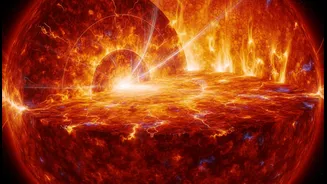
The Sun isn't a simple ball of fire. It has a complex internal structure, much like the Earth has a crust, mantle, and core. At its heart is the core, where nuclear fusion generates immense energy. This energy travels outward through the vast radiative
zone, a region so dense it can take a photon hundreds of thousands of years to cross. The outermost layer of the interior is the convection zone. Here, hot plasma rises, cools, and sinks in a perpetual boiling motion, carrying heat to the surface. For a long time, the boundary between the calm radiative zone and the turbulent convection zone was thought to be a simple transition. But scientists have discovered it's home to one of the most important and mysterious features of the entire star.
Meet the Tachocline
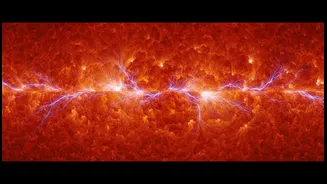
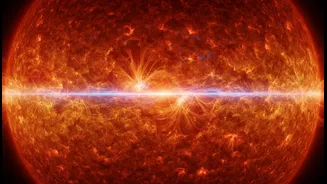
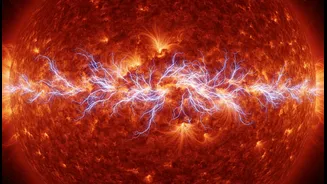
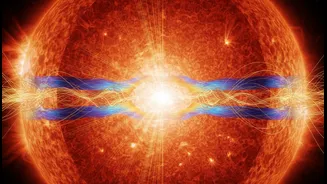
Sandwiched between the radiative and convective zones is the tachocline. First theorised in 1992, it is a remarkably thin layer, estimated to be less than 5% of the Sun's radius. What makes this region so special is a dramatic clash of motion. The radiative zone below it rotates like a solid object, a single rigid ball. In stark contrast, the convection zone above it spins differentially, meaning its equator rotates much faster than its poles. The tachocline is the shear layer where these two vastly different types of rotation meet, creating an environment of incredible stress and turbulence. Think of it as a boundary where a smoothly spinning ball is encased in a fluid that is churning at different speeds; the friction and shear at that interface would be immense.
The Engine of the Solar Dynamo
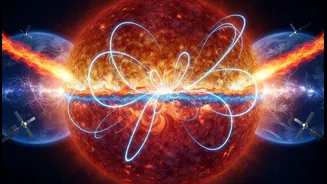
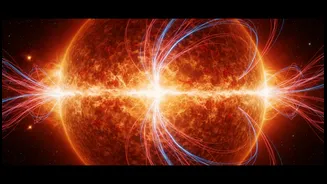
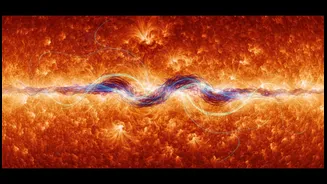
This intense shear is believed to be the heart of the Sun's magnetic field generation, a process known as the solar dynamo. The Sun's plasma is electrically charged, and as it moves, it drags magnetic field lines along with it. In the tachocline, the differential rotation stretches and winds these field lines around the Sun, much like twisting a rubber band. This process, sometimes called the 'omega effect', drastically strengthens the magnetic field. This newly intensified magnetic field is then further twisted by the convective motions, creating complex magnetic loops. The tachocline is the critical location where the initial, weaker magnetic fields are amplified into the powerful, complex fields that define the Sun's activity.
From Deep Within to Solar Storms
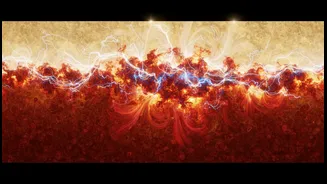
The magnetic energy built up in the tachocline doesn't stay locked away. These strengthened and twisted magnetic fields eventually become unstable and buoyant, rising through the convection zone to pierce the Sun's visible surface, the photosphere. When these powerful magnetic loops emerge, they create sunspots, which are cooler, darker areas of intense magnetic activity. Often, the tangled magnetic field lines above these sunspots can snap and reconnect, unleashing tremendous bursts of energy. These events are what we know as solar flares and coronal mass ejections (CMEs), the primary components of what we call space weather. In essence, the conditions deep inside the tachocline directly lead to the explosive events on the Sun's surface.
Why a Hidden Layer Matters on Earth
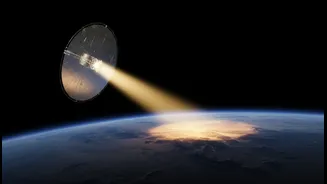
While the tachocline is 150 million kilometres away, its influence is felt right here in India and across the globe. The CMEs and solar flares it helps generate send streams of charged particles and radiation hurtling towards Earth. These can have significant effects on our technology-dependent society. Satellites used for communications, weather forecasting, and GPS navigation are particularly vulnerable to damage from these energetic particles. Severe solar storms can also induce powerful electrical currents in our power grids, potentially causing widespread blackouts, as was seen in Quebec, Canada, in 1989. Furthermore, they can disrupt high-frequency radio communications, which are vital for aviation and emergency services.