




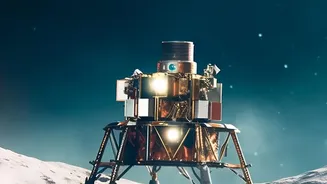
The Frozen Frontier: Why the South Pole?
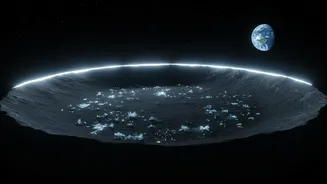
The Moon's south pole is a region of extreme contrasts. While some areas experience sunlight, others are permanently shrouded in darkness. These Permanently Shadowed Regions (PSRs) are some of the coldest places in our solar system, with temperatures
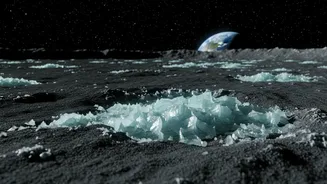
plunging to around minus 250 degrees Celsius. Scientists believe these ultra-cold craters have acted as 'cold traps' for billions of years, preserving water ice delivered by comets and asteroids. India's own Chandrayaan-1 mission in 2008 played a key role in the initial discovery of water molecules, and recent data from the Chandrayaan-2 orbiter has provided even stronger evidence of subsurface ice in these shadowed craters. This makes the south pole a prime location for future exploration and resource utilisation.
ISRO's Two-Pronged Approach
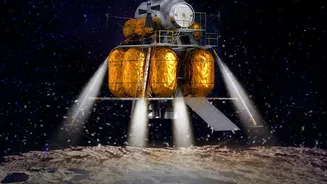
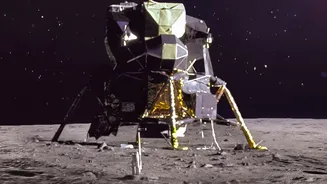
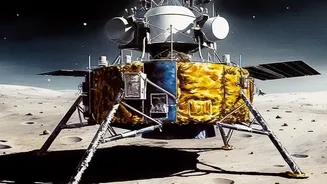
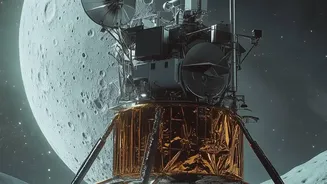
To tackle this challenge, ISRO is pursuing two key missions. The first is Chandrayaan-4, a solo Indian mission planned for around 2028. Its primary objective is to soft-land near the south pole, use a robotic arm to collect lunar soil and rock samples—potentially containing ice—and return them to Earth for detailed study. This mission is incredibly complex, requiring multiple launches and in-orbit docking manoeuvres. The second, also known as Chandrayaan-5, is the Lunar Polar Exploration Mission (LUPEX), a joint project with the Japan Aerospace Exploration Agency (JAXA). For this mission, ISRO will develop the lander, while JAXA will provide the rover. LUPEX aims to spend an extended period exploring the polar region, drilling into the surface, and analysing the quantity and quality of water ice.
The Technology for Extraction
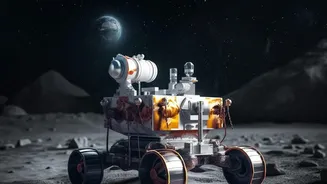
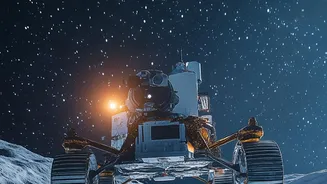
Extracting resources on another world requires a new generation of technology. The LUPEX rover, developed by JAXA, will be equipped with a drill capable of penetrating the lunar surface to search for buried ice deposits. Both missions will carry a suite of advanced scientific instruments. For LUPEX, this includes payloads from ISRO, JAXA, NASA, and the European Space Agency (ESA). A key NASA instrument, the Neutron Spectrometer System (NSS), will be onboard to detect hydrogen—a tell-tale sign of water—without needing to drill. Chandrayaan-4 will feature a robotic arm for sample collection and sophisticated systems to transfer and seal the samples for their journey back to Earth. These technologies are crucial stepping stones for India's long-term goal of a crewed lunar landing by 2040.
Why Lunar Water is a Game-Changer
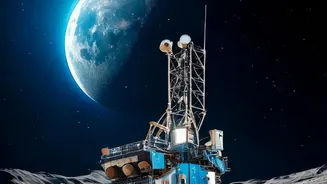
The presence of accessible water on the Moon is not just a scientific curiosity; it's a strategic resource that could revolutionise space exploration. Launching materials from Earth is incredibly expensive. If water ice can be harvested on the Moon, it can be purified for drinking and growing food. More importantly, it can be split into its core components: hydrogen and oxygen. These elements are not only essential for breathable air but are also the primary components of rocket propellant. This concept, known as in-situ resource utilization (ISRU), means the Moon could one day serve as a refuelling station and a staging point for more ambitious missions deeper into the solar system, such as to Mars.
India's Role in the New Space Race
ISRO's focus on lunar ice places India at the heart of a new, resource-driven space race. Major global powers, including the United States with its Artemis program and China with its planned International Lunar Research Station, are all targeting the south pole for the same reason. By developing the capability to land, explore, and potentially extract these resources, India is not just participating but establishing itself as a key scientific and technological leader. The success of Chandrayaan-3 has already proven ISRO's expertise in precision landing in this challenging region. The upcoming missions to 'mine' for water ice will solidify the nation's role as a crucial partner and pioneer in humanity's return to the Moon and a future sustainable presence in space.