








Our Planet's Permanent Eyes Under the Sea
For centuries, the deep ocean has been a realm of mystery, explored only through brief, targeted expeditions. But what if we could watch the ocean continuously, 24/7? That is the promise of deep-ocean observatories. These are not single ships or submarines,
but sophisticated networks of instruments, sensors, and cameras anchored to the seabed. Connected by high-speed cables or communicating via satellite, they provide a constant stream of data on everything from water temperature and chemistry to the faintest rumblings of the Earth's crust. This long-term, high-resolution monitoring allows scientists to move beyond snapshots and see the ocean as it truly is: a dynamic system full of processes that unfold over hours, seasons, and decades. They are our permanent eyes in the deep, taking the pulse of the planet in places we could previously only visit.
Seafloor Spreading: The Earth's Engine
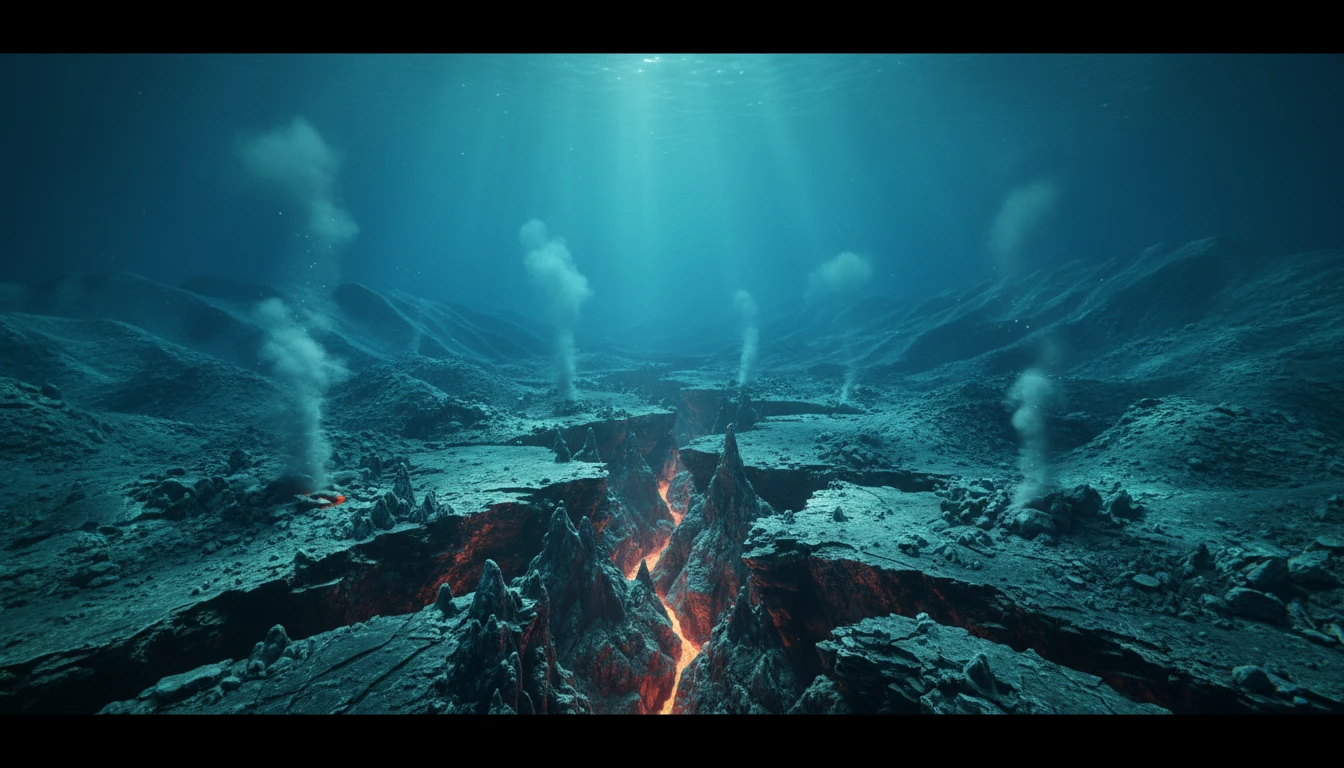
One of the most fundamental processes these observatories help us understand is seafloor spreading. It's a key part of plate tectonics, the grand theory explaining how our planet's continents and oceans are shaped. Imagine the Earth’s crust as a collection of massive, slow-moving puzzle pieces. At mid-ocean ridges, these pieces are pulling apart. As they separate, molten rock, or magma, from the mantle below rises to fill the gap. This magma cools and solidifies, creating brand-new oceanic crust. This process literally paves the ocean floor, with the newest rock at the ridge's center and progressively older rock further away. Mid-ocean ridges are essentially giant construction zones for the planet's surface, driving continental drift, triggering earthquakes, and fueling volcanic activity. They are the engines of plate tectonics, constantly reshaping our world.
A Groundbreaking Event in the Indian Ocean
The Indian Ocean is home to a vast network of ridges, including the Central Indian Ridge and the Southeast Indian Ridge. These have long been of interest to scientists, but studying them has been a challenge. Recently, however, researchers witnessed something extraordinary. In April 2024, an array of instruments deployed on the Southeast Indian Ridge captured a seafloor spreading event in real time, a scientific first. A swarm of earthquakes was detected as the valley floor sank by four meters and the seafloor stretched apart by more than a metre in just days. This was followed by a massive eruption, with an estimated 160 million cubic metres of lava pouring out to form new ocean floor. Before this, our understanding of these events was based on studying ancient evidence. Observing a complete spreading episode as it happened has provided an unprecedented look into the mechanics of how our planet creates new crust.
Why This Matters for India
For India, with its extensive coastline and strategic position, understanding the Indian Ocean is not just an academic exercise. This research has profound practical implications. Studying tectonic movements helps improve our assessment of earthquake and tsunami risks, which is vital for coastal communities. Furthermore, the hydrothermal vents found along mid-ocean ridges are known to host rich deposits of valuable minerals like copper, cobalt, and nickel. India's Deep Ocean Mission, a flagship initiative, is geared towards exploring these very resources. Projects like the 'Samudrayaan' mission, which aims to send a three-person crew to depths of 6,000 meters in a submersible named 'Matsya 6000', will place India in an elite club of nations with deep-sea exploration capabilities. This technological push is crucial for harnessing the 'Blue Economy' sustainably, ensuring energy security, and cementing India’s role as a leader in marine science.
The Future of Ocean Exploration
The real-time observation of seafloor spreading in the Indian Ocean marks a new era in Earth science. The data collected by these deep-ocean observatories is not just about geology; it's about understanding the entire Earth system. These platforms monitor ocean chemistry, which is crucial for tracking climate change and its impacts. They reveal new deep-sea ecosystems with unique life forms that could hold the key to breakthroughs in medicine and biotechnology. As part of its Deep Ocean Mission, India is planning its own deep-sea observing systems, potentially including a permanent underwater research laboratory. Such an 'International Space Station' of the deep would enable scientists to conduct long-term experiments in one of the most extreme environments on Earth, unlocking secrets that are currently beyond our reach.