


What We Can Predict: The Planet Killers
Humanity has made incredible strides in detecting large, potentially hazardous near-Earth objects (NEOs). Thanks to efforts led by NASA and international partners, we have a good handle on the biggest threats. Programs like the Catalina Sky Survey and Pan-STARRS
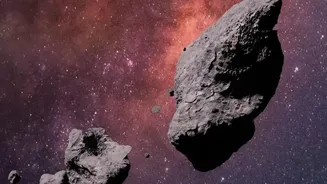
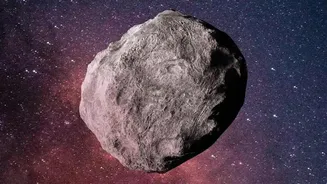
have mapped over 90% of NEOs larger than one kilometre in diameter — objects big enough to cause global devastation. NASA's Planetary Defense Coordination Office (PDCO), established in 2016, acts as the nerve centre for these efforts. It catalogues NEOs, calculates their orbits, and assesses potential impact risks. An object is deemed a "potentially hazardous asteroid" (PHA) if it is larger than about 140 meters (460 feet) and its orbit brings it within 7.5 million kilometres of Earth's. For these larger objects, detection systems can often provide decades or even centuries of warning, giving humanity time to plan a response, such as the successful DART mission which proved we can alter an asteroid's path.
What We Can Predict: Calculating Orbits and Close Approaches
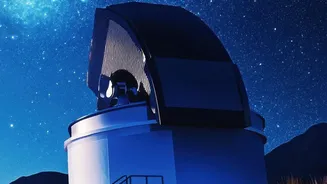
Detecting an object is only the first step. Once a new NEO is spotted by comparing multiple images of the sky taken minutes apart, astronomers get to work. By tracking the object's movement against the fixed background of stars, they can calculate its trajectory. The Center for Near Earth Object Studies (CNEOS) at NASA's Jet Propulsion Laboratory is responsible for this critical task. As more observations are collected over time from observatories around the world, the accuracy of an object's predicted orbit improves dramatically. This allows CNEOS to forecast close approaches and determine if an asteroid has any chance of hitting Earth in the next 100 years. If the probability of an impact from a hazardous object is 1% or greater in the next 50 years, the PDCO issues formal warnings.
What We Cannot Predict: The Sun's Glare
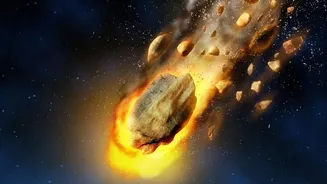
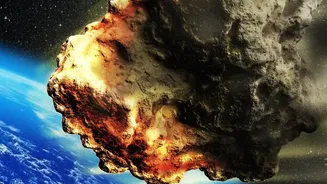
One of the most significant blind spots in our detection network is the area of the sky near the Sun. Asteroids approaching from this direction are cloaked by the Sun's intense glare, making them nearly impossible for ground-based optical telescopes to see. These telescopes can only operate at night, when the Sun is well below the horizon. This creates a dangerous vulnerability, as demonstrated by the 2013 Chelyabinsk meteor. This 20-meter rock came from the direction of the Sun and exploded over Russia with no warning, injuring hundreds and causing widespread damage. It served as a stark reminder that even smaller asteroids can pose a threat if they arrive unseen.
What We Cannot Predict: Smaller, Darker Rocks
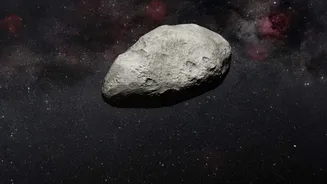
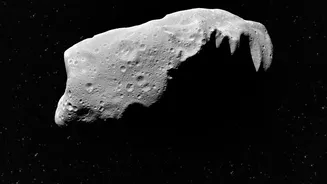
While we are proficient at finding giant asteroids, our ability to detect smaller ones is far less complete. It's estimated that we have found less than half of the PHAs in the 140-meter range — asteroids large enough to destroy a city. For even smaller objects, around 50 meters in diameter, the detection rate is even lower. Many of these rocks are as dark as charcoal and reflect very little light, making them incredibly faint and difficult to spot against the blackness of space. Scientists estimate there are tens of millions of small near-Earth objects, but less than 1% have been discovered so far. These smaller objects, while not a threat to civilization, can still cause significant regional damage and remain a major challenge for current survey technologies.
The Future of Detection: Eyes in the Sky
To address these limitations, space agencies are developing next-generation technology. A key upcoming mission is NASA's NEO Surveyor, an infrared space telescope specifically designed to find the asteroids we are currently missing. By detecting the heat signature asteroids give off after being warmed by the Sun, rather than the faint visible light they reflect, NEO Surveyor will be able to spot dark objects more easily. Crucially, it will also be positioned to scan regions of space obscured by the Sun's glare, helping to close our most dangerous blind spot. Expected to launch no earlier than September 2027, NEO Surveyor will work with ground-based observatories like the Vera C. Rubin Observatory to drastically accelerate the rate at which we discover the remaining hazardous NEO population, making our planet a safer place.