






The Case for Curves
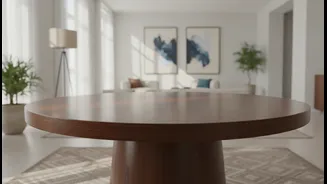
Devotees of the round table praise its ability to create a more intimate and social dining experience. With no head of the table, everyone is positioned equally, which encourages more inclusive conversation. People can easily see and engage with everyone else,
fostering a connected, communal atmosphere that can feel less formal and more inviting than a long, rectangular setup. This shape is also a clear winner for families with small children, as the absence of sharp corners means fewer bumps and bruises. The soft, curved lines can also make a room feel gentler and more open, breaking up the straight lines and hard angles that often dominate our living spaces.
Improving the Flow
One of the most significant advantages of a round table is its impact on a room's traffic flow. The lack of corners allows people to move around it more easily, creating a smoother path through the space. This is particularly beneficial in smaller dining areas, open-plan layouts, or high-traffic zones where a rectangular table might create a bottleneck. A round table’s smaller physical and visual footprint can make a compact area feel more spacious and less cluttered. For square-shaped rooms, a round table is often the perfect fit, maintaining the room's natural balance and symmetry.
The Space It Wastes
Despite their benefits, round tables are not a universal solution. Their biggest drawback is how they interact with the shape of a room. In a long, narrow dining room, a round table can be a disaster, creating awkward, unusable dead space on either side. While it feels like a circle should be efficient, a large round table requires a significant amount of clearance space all around it to be functional. A rectangular table can be pushed against a wall, but a round table cannot sit flush against a flat surface, often making it a poor choice for very small apartments where every inch counts. Furthermore, while you can often squeeze an extra chair around a round table, seating a large group can become impractical as the table gets bigger, pushing diners further apart and creating a vast, empty space in the middle.
Making the Right Choice
So, how do you decide? The answer lies in your room's dimensions and your lifestyle. Start by measuring your space. As a rule of thumb, you need about 90 to 100cm of clearance around your table to allow for chairs to be pulled out and for people to walk by. If you have a square room or a small breakfast nook, a round table is likely an excellent choice. If your dining area is long and rectangular, a rectangular table will almost always make better use of the floor plan. Also, consider your hosting needs. If you frequently entertain large groups, a rectangular table's ability to seat more people is a clear advantage. For those wanting a middle ground, an oval table offers the best of both worlds: the linear efficiency of a rectangle with the softer, flowing feel of a circle.