






A New Blueprint for Mars
In a significant strategic shift, NASA has awarded approximately $17 million in contracts to seven companies under a new initiative called STRIDE, which stands for Science Transport and Robotic Innovation for Deployment and Exploration. This move signals
a deeper commitment to public-private partnerships, a model that has already shown success in launching cargo and astronauts to low-Earth orbit. Instead of relying solely on its internal teams at labs like the Jet Propulsion Laboratory (JPL), the agency is now actively outsourcing early-stage design and development for some of its most critical future technologies. The goal is to accelerate innovation, reduce costs, and create a more frequent cadence of missions to Mars by tapping into the agility and diverse expertise of the commercial space and robotics sectors. This approach allows NASA to identify key technology gaps while fostering a broader industrial base capable of supporting long-term exploration goals.
Meet the Innovators
The seven companies selected represent a cross-section of the American aerospace and robotics industries. The list includes AeroVironment, known for its pioneering work on the Mars Ingenuity helicopter; Astrobotic and Intuitive Machines, both successful lunar lander companies; and Honeybee Robotics, a veteran in developing planetary drills and sampling systems. They are joined by Venturi Astrolab, Ground Control Robotics, and MEI Technologies, firms that bring fresh perspectives on mobility and robotic systems. This diverse portfolio of partners—ranging from established aerospace giants to more specialized robotics firms—is intentional. By casting a wide net, NASA aims to gather a variety of innovative concepts for robotic mobility, ensuring that the best and most resilient ideas rise to the top as it plans more ambitious scientific campaigns on the Martian surface.
The Tech on the Drawing Board
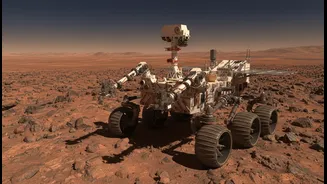
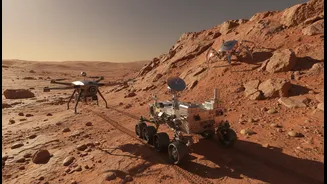
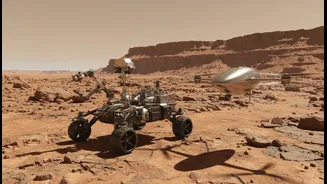
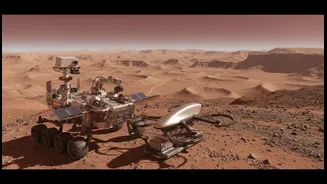
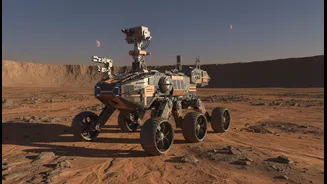
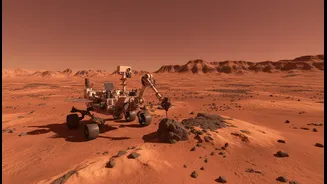
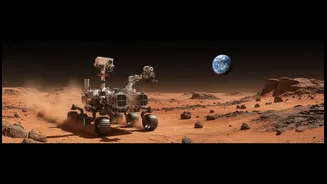
These contracts are not for building full-fledged rovers just yet. Instead, they are for foundational design studies and concepts that could overcome the limitations of current explorers like the Perseverance and Curiosity rovers. Future missions require robots that can travel greater distances and access scientifically rich but hard-to-reach locations, such as steep crater walls, ancient riverbeds, and potential cave entrances. The STRIDE initiative is focused on developing both surface and aerial technologies that can carry scientific payloads across these challenging Martian landscapes. Past rovers have sometimes struggled with difficult terrain like fine sand, and their range is limited. The new concepts developed under these contracts will explore novel solutions for mobility, power, and autonomy, paving the way for a new generation of robotic scouts that can go farther and discover more than ever before.
Why Evidence Still Matters
While the announcement is exciting, the headline's caution that "evidence still matters" is a crucial reminder of the brutal realities of space exploration. Mars is an unforgiving environment, with extreme temperature swings, a thin atmosphere, and abrasive, rusty dust that can cripple complex machinery. A clever design on a computer screen is a world away from a piece of hardware that can survive a multi-month journey through deep space and then function reliably for years on another planet. Every component, from the simplest bolt to the most complex sensor, must be rigorously tested and proven to withstand these conditions—a process that can take years and cost millions. These initial study contracts are the very first step on a long and difficult path. The companies will have to prove, through analysis, simulation, and eventually prototype testing, that their ideas are not just innovative but genuinely viable for the Red Planet. Many promising technologies fail to make the leap from concept to a flight-ready system, a gap often called the 'valley of death' in aerospace engineering.