




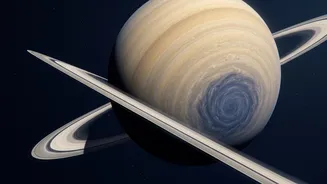
A New Shape in the Clouds
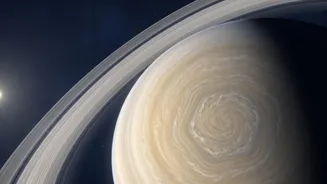
Planetary scientists are buzzing about a newly identified atmospheric wave encircling Saturn's south pole. Using the Hubble Space Telescope, a team of astronomers has confirmed the existence of a massive, 10-sided feature, or decagon, that has been developing
in recent years. This enormous structure, roughly 104,000 miles across, was first hinted at in data from 2023 but has become much more defined in subsequent observations. The discovery was a collaborative effort, with hints from amateur astronomers helping to guide the professional analysis of Hubble imagery. Unlike its long-observed northern sibling, this southern polygon appears to be a recent development; it was not seen by the Cassini spacecraft, which extensively studied Saturn from 2004 to 2017.
North vs. South: A Tale of Two Poles
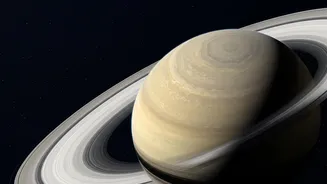
The discovery immediately invites comparison to the famous hexagonal storm at Saturn's north pole, a fixture since it was first spotted by the Voyager probes over 40 years ago. But this new southern storm is not an identical twin. For starters, it has ten sides instead of six. Furthermore, the northern hexagon has been remarkably stable for decades, while the southern decagon appears to be a dynamic, evolving feature that has only just formed and seems to be strengthening. Scientists note that while the northern hexagon is quite fixed, the southern decagon seems to 'wobble' on a 32-day cycle. This difference raises fascinating questions: Why are the poles different? And why is this southern feature appearing now?
The Science of Celestial Geometry
So, what could create such a massive geometric shape in a planet's atmosphere? The short answer lies in fluid dynamics and jet streams. Scientists believe these polygonal patterns are standing waves located within powerful jet streams that circle the planet's poles. Imagine a river flowing very fast; disturbances in the flow can create stable, repeating patterns. On Saturn, the planet’s rapid rotation and atmospheric conditions conspire to lock these waves into a geometric shape. Laboratory experiments have managed to replicate similar polygonal shapes by spinning tanks of liquid at different speeds. Researchers are using computer simulations to understand the exact conditions that led to the decagon's formation, with some theories suggesting it may be driven by a nearby swirling vortex.
Why This Discovery Matters
This finding is more than just a cosmic curiosity. For years, the northern hexagon was considered a unique anomaly. The appearance of a second, different polygon suggests that such features might be a more common, though perhaps transient, aspect of gas giant atmospheres. The fact that it formed so recently gives scientists a rare opportunity to watch a massive planetary weather system develop in real time. This provides invaluable data for understanding the deep atmospheric layers of gas giants. By studying how and why these giant storms form and evolve, scientists can learn more about the planets' internal structures and the fundamental physics that govern their atmospheres. The discovery was made possible by the Outer Planet Atmospheres Legacy (OPAL) program, which uses Hubble to take yearly portraits of the outer planets, allowing for the tracking of slow changes over time.