


The Universe's Biggest Mystery
Imagine throwing a ball into the air. You expect gravity to pull it back down. Now, imagine that after slowing down, the ball suddenly starts accelerating upwards on its own. That’s essentially what our universe is doing. For decades, scientists have
known the universe is expanding. But in the 1990s, they discovered this expansion is accelerating. To explain this baffling phenomenon, they proposed the existence of a mysterious, invisible force that makes up roughly 70% of the universe: dark energy. It acts like a kind of cosmic anti-gravity, pushing everything apart at an ever-increasing rate. Pinpointing what dark energy is, and how it behaves, remains one of the most profound challenges in modern physics.
A Cosmic Listening Post
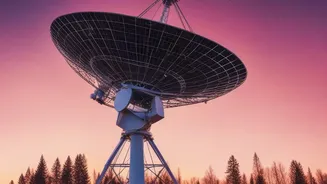
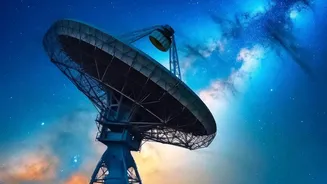
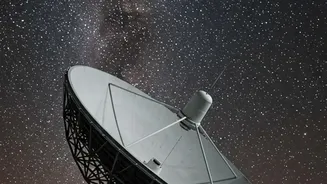
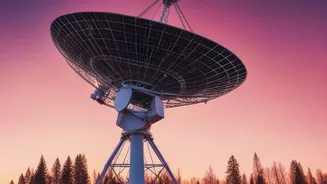
Enter the Canadian Hydrogen Intensity Mapping Experiment, or CHIME. Located in British Columbia, Canada, CHIME is not your typical telescope that creates beautiful images of stars and galaxies. It consists of four large, half-pipe-shaped metal mesh reflectors with no moving parts. As the Earth rotates, it passively scans the entire northern sky every single day. CHIME was specifically designed to do one thing exceptionally well: detect the faint radio waves emitted by hydrogen, the most abundant element in the cosmos. By mapping the distribution of hydrogen across vast stretches of space and time, scientists can create a 3D map of the universe's large-scale structure. This map, in turn, allows them to trace the history of cosmic expansion.
What Did CHIME Actually Find?
The recent excitement is about a major technical milestone. For the first time, CHIME has detected the faint glow of hydrogen gas from when the universe was about five billion years old, using only its own data. Previously, to confirm its findings, CHIME had to cross-reference its observations with data from other, more expensive optical telescopes. This new result, published in The Astrophysical Journal, proves that CHIME's 'intensity mapping' technique works on its own. It successfully filtered out a sea of noise from human activity and closer cosmic objects to isolate the specific, ancient signal. This is a game-changer because it provides a faster, cheaper, and more efficient way to map enormous volumes of the universe.
A New Tool, Not a Final Answer
So, why doesn't this solve the dark energy puzzle? The headline is correct: the finding itself does not yet explain dark energy. What it does is validate a powerful new method for studying it. Think of it like a mechanic forging a unique new wrench. They haven't fixed the engine yet, but they've proven they have a new tool that can reach bolts no one else could. By mapping hydrogen, CHIME can measure something called Baryon Acoustic Oscillations (BAOs) — essentially, giant patterns or ripples in the distribution of matter left over from the early universe. These patterns serve as a 'standard ruler' to measure cosmic expansion. The recent finding confirms that CHIME can detect the necessary signals to use this ruler. It's a proof of concept, not the final measurement that will constrain or define the properties of dark energy.
The Search Continues
This achievement is just the beginning. The groundbreaking result was based on just 94 nights of observation data from 2019. The CHIME team now has nearly seven years of data to analyze, which will allow them to create a much more detailed map and peer even further back in time. As they refine their techniques and analyze this wealth of information, they will be able to make increasingly precise measurements of the universe's expansion history. This will help scientists test competing theories about dark energy—is it constant, or does it change over time? While CHIME may not have delivered the final word on dark energy, it has successfully opened a powerful new window on the cosmos, promising a new era in our quest to understand the universe's ultimate fate.