








The Allure and Dangers of the Monsoon
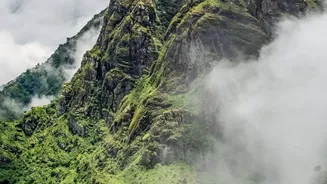
Every year, from June to September, the Sahyadri mountains shrug off their dry, brown coat and wrap themselves in a vibrant green. Waterfalls burst from cliffs, rivers swell with life, and a cool mist hangs in the air. For adventure seekers, it’s an irresistible
call. However, the same rains that bring this beauty also introduce serious dangers. Trails can become slick and treacherous, visibility can drop to near zero in minutes, and, most critically, streams can turn into raging torrents. Flash floods in narrow gullies and landslides are a constant threat, turning a scenic hike into a life-threatening situation. Several popular trekking routes in Maharashtra, Goa, and Karnataka are now restricted or even banned during peak monsoon months to prevent accidents. Incidents of trekkers getting lost or stranded are common, sometimes requiring large-scale rescue operations.
More Than a Smartphone App
While many trekkers carry a smartphone with GPS, these are often unreliable in the backcountry. Poor battery life and the complete absence of mobile networks in remote valleys render them useless in an emergency. This is where dedicated GPS devices like Personal Locator Beacons (PLBs) and satellite messengers come in. Unlike phones, these devices communicate directly with satellites, meaning they work anywhere on the planet with a clear view of the sky. A PLB is a one-way communication tool; when you press its SOS button, it sends a distress signal with your precise GPS coordinates to an international rescue network. Satellite messengers offer two-way communication, allowing you to send and receive text messages, get weather updates, and share your location, all without a cell signal.
A Lifeline in the Wilderness
The primary function of a GPS beacon is as an emergency lifeline. For a lost or injured trekker, activating the device can reduce search and rescue times from days to hours. Instead of a wide, uncertain search area, rescue teams get exact coordinates, which is critical when dealing with injuries or hypothermia. In April 2026, a trekker got separated from her group in the Kodagu region of the Western Ghats and spent nearly three days alone in the forest before being found; her phone was useless due to lack of network coverage. A GPS beacon could have alerted authorities to her exact location immediately. These devices provide a direct link to help, a feature that is invaluable when traditional communication fails.
Proactive Safety, Not Just Reactive Rescue
Beyond the red SOS button, the evolving technology in satellite messengers allows for proactive safety. Tour group leaders can use these devices for dynamic route planning. If a weather update warns of a heavy downpour upstream, a guide can reroute the group to avoid a stream crossing that might become a flash flood zone. While the headline's specific claim of guiding groups away from floods is a key application, the broader use is in overall risk management. Some devices allow a base camp to track a group's progress in real-time, offering advice or warnings. This turns the beacon from a mere emergency tool into a constant, live-saving communication channel, much like how GPS tracking is used to monitor animal movement during floods in other parts of India to ensure their safety.
A Tool, Not a Magic Wand
While GPS beacons dramatically improve safety, they are not a substitute for experience and preparation. Experts caution that trekkers must still carry essential monsoon gear like trekking poles, waterproof layers, and a headlamp. The effectiveness of a beacon depends on it having a charged battery and a clear line of sight to the sky; it won't work from the bottom of a deep, narrow gorge. Furthermore, relying solely on technology can lead to a false sense of security. The best safety plan involves a combination of the right gear, an experienced guide, informing someone of your route, and respecting the weather. The beacon is one crucial part of that system, but it's the trekker's judgment that remains the most important safety tool of all.