




The Cosmic Gumball Machine
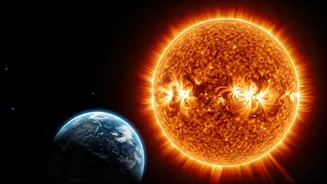
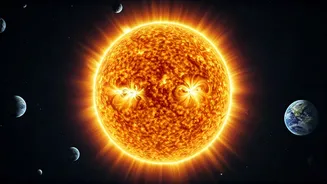
So, where does that 'one million' number come from? It’s a simple, if mind-bending, calculation of volume. The Sun’s diameter is about 865,000 miles, roughly 109 times the diameter of Earth. But when you calculate volume—the total space an object occupies—that
difference becomes astronomical. Think of it this way: if you have a box that’s twice as wide, twice as long, and twice as high as another, its volume isn't double; it’s eight times greater (2x2x2). Apply that cubic relationship to the Sun’s 109x diameter advantage, and you find its volume is about 1.3 million times that of Earth's. So why the 'one million' figure? It’s a clean, conservative, and memorable number. Plus, there’s a fun wrinkle. If you were actually trying to pack Earths into the Sun like gumballs in a machine, the spherical shape of our planet would leave gaps. This 'sphere-packing problem' means you couldn't use 100% of the Sun’s volume. Physicists estimate you could only fill about 74% of the space. That brings the number of 'packable' Earths down to around 960,000. So, 'one million' isn't just a great estimate; it’s surprisingly accurate for a real-world (or real-solar-system) scenario.
It's a Matter of Weight, Too
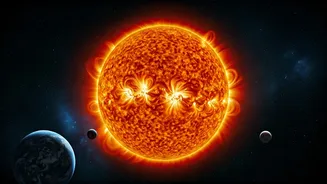
While the Sun wins the size competition by a landslide, the difference in mass—the actual amount of 'stuff' it's made of—tells an even crazier story. The Sun accounts for a staggering 99.86% of all the mass in our entire solar system. Everything else—all the planets, moons, asteroids, and comets combined—makes up the leftover 0.14%. But here’s the twist: while the Sun is 1.3 million times larger than Earth by volume, it's 'only' about 333,000 times more massive. What gives? Density. Earth is a dense, rocky planet. The Sun, on the other hand, is an enormous ball of incredibly hot gas, primarily hydrogen and helium. It’s like comparing a bowling ball to a giant, fiery hot-air balloon. The balloon is vastly larger, but the bowling ball packs more substance into its small frame. The Sun’s immense gravitational pull is what holds our solar system together, keeping Earth in a stable orbit from 93 million miles away. It’s so dominant that it dictates the motion of everything around it.
Putting Scale into Perspective
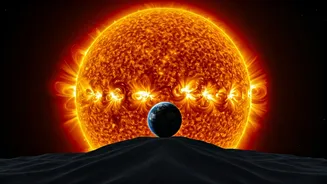
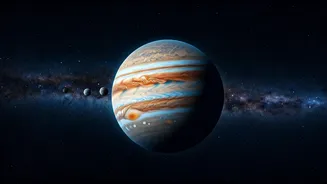
Numbers like 'one million' and '333,000' are too abstract to really grasp. So, let’s try some analogies. If you were to shrink the Earth down to the size of a standard blueberry, the Sun would be a five-foot-wide yoga ball. Imagine holding that tiny blueberry while standing next to a sphere taller than you are wide. That's the scale we're talking about. Here’s another one: if the Sun were the size of a typical front door, Earth would be the size of a nickel. Jupiter, our solar system's largest planet, would be about the size of a basketball. All the other planets would be smaller pebbles and specks of dust. Visualizing it this way helps transform a sterile fact into a visceral feeling of scale. Our entire world, with all its mountains, oceans, and cities, becomes a mere coin in the shadow of a doorway.
Not Just an Empty Sphere
It’s crucial to remember that the Sun isn't a hollow container waiting to be filled. It's the most violent and powerful place in our solar system. The core is a nuclear fusion reactor, burning at 27 million degrees Fahrenheit, converting hydrogen into helium and releasing unimaginable amounts of energy. This energy radiates outward, creating the light and heat that make life on Earth possible. That 'comfortable' fit in the headline is pure fantasy. Any object approaching the Sun would be vaporized by its intense heat and radiation long before it ever reached the 'surface,' or photosphere. The Sun's surface itself is a churning, boiling cauldron of plasma, constantly erupting with solar flares and coronal mass ejections that can hurl charged particles across the solar system, powerful enough to disrupt satellites and power grids here on Earth. So, while it's a fun thought experiment, the Sun is less of a gumball machine and more of a star-sized furnace.