



A New Era for Space Operations
For decades, managing satellites involved a continuous conversation with ground control. Operators would send commands, and satellites would execute them. This model worked well, but the space environment has changed dramatically. The skies are now crowded
with an unprecedented number of satellites and a growing cloud of space debris. In this new era, relying solely on ground commands is becoming too slow and risky. To address this, ISRO has been developing and implementing AI and machine learning solutions for everything from launch vehicle design to spacecraft operations and space traffic management. This shift is not just about upgrading systems; it's about fundamentally changing how India manages its vital assets in orbit.
AI: The Satellite's Autonomous Brain
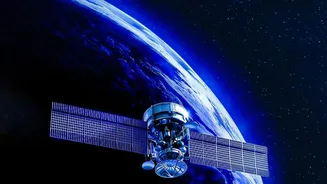
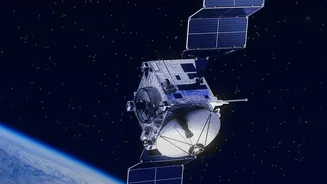
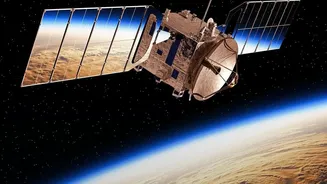
Artificial intelligence gives satellites the ability to think for themselves. Instead of waiting for instructions from Earth, an AI-powered satellite can make critical decisions in real time. One of the most important applications is autonomous navigation and collision avoidance. With AI algorithms, a satellite can detect a potential collision with debris or another satellite and automatically adjust its orbit to safety, a process that would take precious time with human intervention. Furthermore, AI is crucial for managing the massive amounts of data collected by modern satellites. ISRO is exploring on-board processing and edge computing, which would allow satellites to analyze data in orbit and send back only the most critical insights, such as disaster alerts or crop health metrics. This reduces the strain on communication bandwidth and allows for faster decision-making on the ground. AI is also being used for predictive health monitoring, allowing a satellite to diagnose its own potential failures before they become critical.
Quantum Science: The Unbreakable Shield
While AI gives satellites autonomy, quantum science promises to make them invincible from a communications standpoint. Traditional encryption relies on complex mathematical problems that, in theory, could be broken by powerful future computers. Quantum communication, however, is based on the fundamental laws of physics. ISRO is heavily invested in developing Quantum Key Distribution (QKD), a technology that uses the principles of quantum mechanics to create unhackable communication channels. If an eavesdropper tries to intercept a quantum key, the very act of observing it changes its state, immediately alerting the sender and receiver. This makes it a perfect solution for securing sensitive military, strategic, and financial data transmitted via satellite.
ISRO's Quantum Leap Forward
ISRO is not just theorizing; it is actively building and testing these capabilities. The organisation has already successfully demonstrated free-space Quantum Communication over a distance of 300 meters, a major milestone toward creating a satellite-based quantum communication network (SBQC). This demonstration involved live, quantum-key-encrypted video conferencing and data transmission. Working in collaboration with institutions like the Raman Research Institute, ISRO is gearing up to demonstrate the technology between two Indian ground stations, with the eventual goal of launching a dedicated QKD satellite. These efforts are part of India's broader National Quantum Mission, positioning the country among an elite group of nations capable of securing its communication networks against any future cyber threats.