



A New Eye on the Cosmos
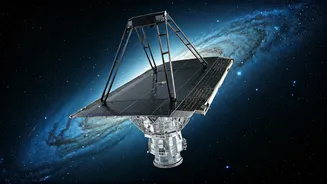
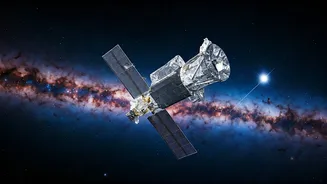
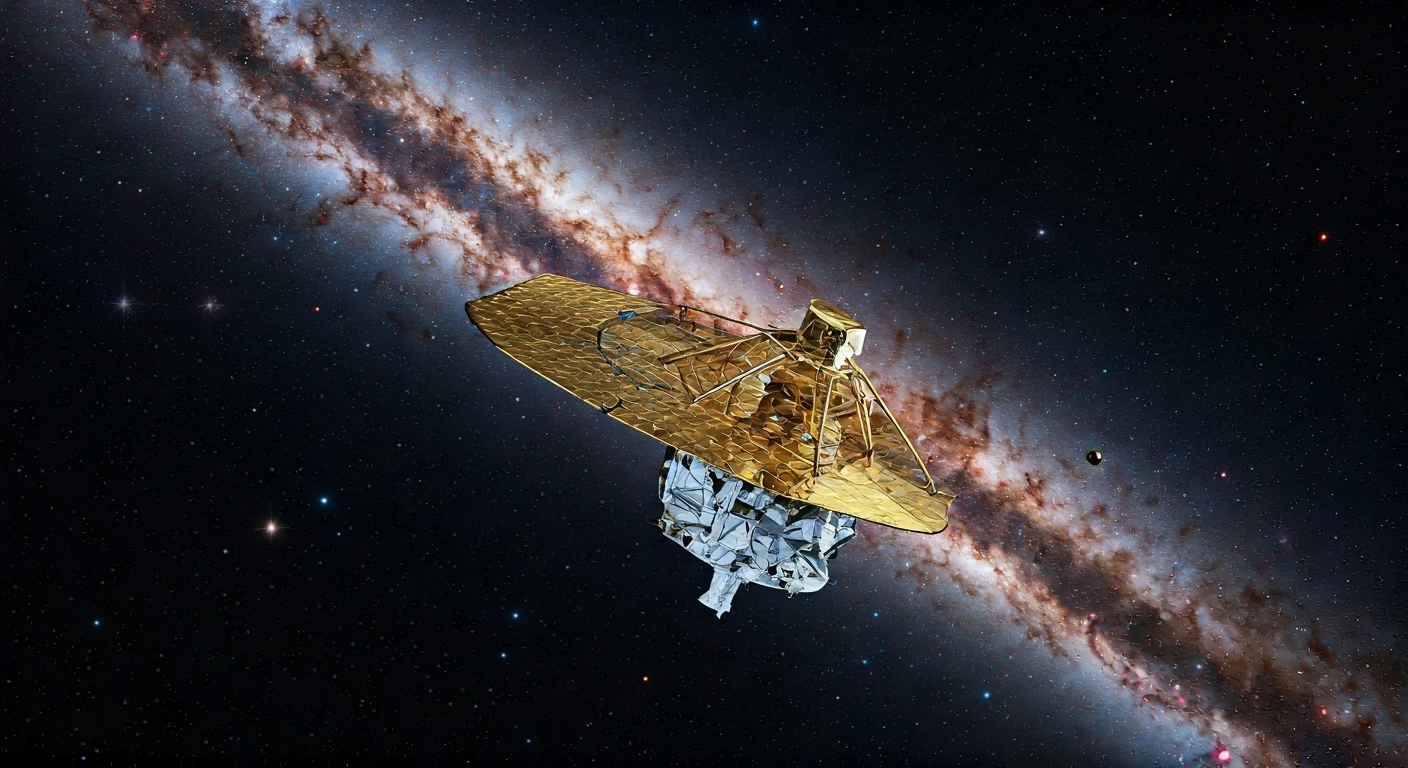
Named after Dr. Nancy Grace Roman, NASA's first chief of astronomy and the “mother of Hubble,” the Roman Space Telescope is a next-generation observatory with a truly unique capability. While its primary mirror is the same size as the Hubble Space Telescope's
at 2.4 meters, its power lies in its immense field of view. Its Wide Field Instrument (WFI) can capture an area of the sky at least 100 times larger than Hubble can in a single image, all with the same stunning resolution. This means Roman can map vast stretches of the universe with incredible speed and efficiency, collecting data on a scale previously unimaginable. Scheduled for launch aboard a SpaceX Falcon Heavy rocket on August 30, 2026, the telescope recently arrived at the Kennedy Space Center to begin final preparations for its five-year primary mission.
Illuminating the Dark Universe
One of Roman’s primary objectives is to tackle one of the biggest puzzles in modern physics: dark energy. This mysterious force is believed to be responsible for the accelerating expansion of the universe, but its nature remains unknown. To investigate, Roman will conduct massive surveys, observing billions of galaxies and thousands of distant exploding stars called Type Ia supernovae. By precisely measuring the positions, shapes, and distances of these objects across cosmic time, astronomers can map the evolution of the universe's expansion. The telescope will use three main techniques: studying the distribution of galaxies for imprints of early sound waves (Baryon Acoustic Oscillations), using supernovae as 'standard candles' to measure cosmic distances, and observing how the light from distant galaxies is bent by the gravity of unseen matter (weak gravitational lensing). These measurements are expected to provide a tenfold improvement in our understanding of dark energy.
A Census of Alien Worlds
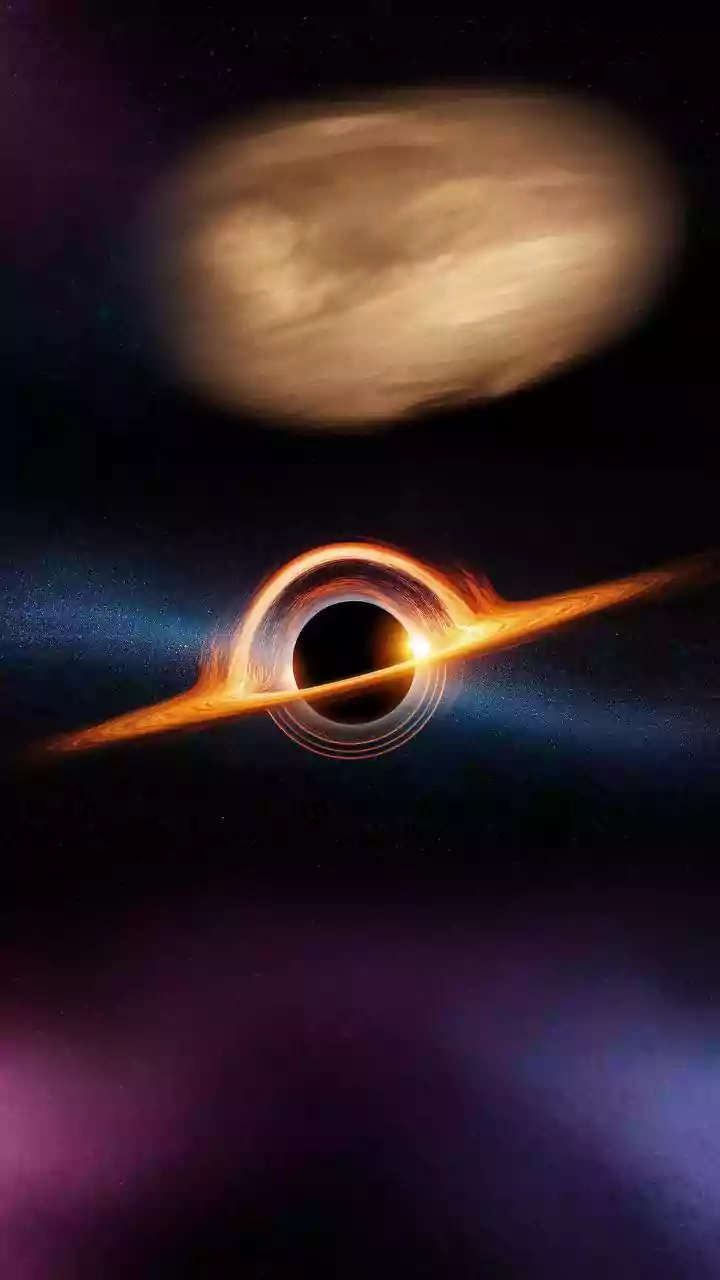
Beyond cosmology, Roman is set to be an exoplanet-hunting powerhouse. While missions like Kepler and TESS have found thousands of planets by watching for the dimming of a star's light as a planet transits, Roman will primarily use a different technique called gravitational microlensing. This method, predicted by Einstein, occurs when a star or planet passes in front of a more distant star, causing the background starlight to be briefly magnified by its gravity. This technique is sensitive enough to find planets much farther away and with a wider range of masses, including rogue planets that don't orbit a star at all. Roman will stare at the dense star fields in the center of our Milky Way, expecting to find thousands of new worlds. It will also use the transit method, and scientists predict it could find as many as 100,000 transiting planets over its lifetime.
Working in Tandem with Webb
Roman is not a replacement for Hubble or the James Webb Space Telescope (JWST) but a powerful complement. While JWST is designed to peer deep into space with a narrow field of view to study the earliest galaxies, Roman is a survey instrument built for breadth, creating vast cosmic panoramas. Think of it this way: Roman will be the scout, identifying tens of thousands of interesting targets, from unusual exoplanets to distant galaxy clusters. Then, Webb can perform deep, focused follow-up observations on the most promising discoveries to analyze their composition and characteristics in detail. In addition, Roman carries a technology demonstration called the Coronagraph Instrument, designed to block the overwhelming glare from a star to directly image large, Jupiter-like planets orbiting nearby. This technology is a critical stepping stone for future missions that aim to directly image Earth-like worlds.