






The Sun's Blinding Glare
One of the biggest challenges in asteroid detection is a massive blind spot: the Sun. Telescopes on Earth and in orbit primarily search for the faint, reflected light of asteroids against the dark night sky. However, if an asteroid is approaching Earth from
the direction of the Sun, its reflected light is completely lost in the Sun's overwhelming glare. These objects can only be observed during the brief twilight window, just before sunrise or after sunset, making them incredibly difficult to find. Astronomers refer to these as 'twilight' asteroids, and they are considered among the most dangerous because they can get dangerously close before we even know they are there.
Size and Composition Matter
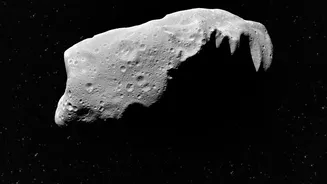
When it comes to detection, size is a crucial factor. The solar system is filled with countless small rocks, many of which are only a few meters across. These are too small to reflect a significant amount of sunlight, making them extremely faint and hard to spot until they are very close. Planetary defense experts are particularly concerned about asteroids in the 140-meter range—large enough to cause significant regional damage but small enough to often evade detection. Compounding the issue is their composition. Many asteroids are very dark, with low-albedo (brightness) surfaces that absorb sunlight rather than reflecting it. Trying to spot a dark, non-reflective object against the blackness of space is a monumental task.
Speed and Unexpected Orbits
Near-Earth objects are not stationary targets; they are moving at incredible speeds. An asteroid's rapid movement across the sky can make it difficult to track and confirm. To identify an asteroid, astronomers take a series of images of the same patch of sky and look for any object that has moved relative to the background stars. This requires multiple observations over a period of time to calculate an accurate trajectory. Some asteroids have highly elliptical or unusual orbits that only bring them into Earth's neighborhood infrequently. Others can appear to move slowly from our perspective, a trick of orbital mechanics that can make them blend in with the background, only to be recognized when they are nearly upon us.
Limitations of Our Sky Surveys
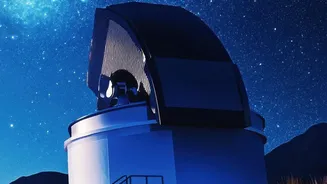
While our planetary defense network has grown significantly, it doesn't cover the entire sky all the time. Ground-based telescopes, which form the backbone of asteroid detection, are limited by factors like weather, daylight, and atmospheric interference. There are a finite number of telescopes dedicated to this work, meaning we can't look everywhere at once. Though programs like the Catalina Sky Survey and Pan-STARRS have discovered thousands of near-Earth objects, experts estimate that we have only found about 40% of the potentially hazardous asteroids that are 140 meters or larger. There are simply more objects out there than our current systems can track comprehensively.
The Future of Asteroid Hunting
The good news is that technology is advancing. Upcoming projects like the Vera C. Rubin Observatory in Chile are expected to dramatically increase our survey capacity. Furthermore, space-based telescopes offer a significant advantage. NASA's upcoming NEO Surveyor mission, launching no earlier than 2027, will be a space-based infrared telescope specifically designed to find hazardous objects. By detecting the heat signature that asteroids emit after being warmed by the sun, NEO Surveyor will be able to spot dark asteroids and those coming from the direction of the sun, filling a critical gap in our current detection capabilities. These efforts, combined with international collaboration and missions like the DART test which successfully altered an asteroid's path, represent a major step forward in protecting our planet.