






A World of Possibility
K2-18b first captured global attention when observations from the James Webb Space Telescope (JWST) unveiled key details about its atmosphere. Located in the habitable zone of its star, this sub-Neptune planet showed the presence of methane and carbon
dioxide. This combination supports a compelling theory: K2-18b could be a "Hycean" world, a hypothetical type of planet featuring a deep liquid water ocean beneath a hydrogen-rich atmosphere. Such conditions make it one of the most promising candidates discovered so far for harbouring life beyond Earth, prompting intense scientific scrutiny. The planet is significantly larger and more massive than Earth, meaning it represents a class of planet entirely different from anything in our own solar system.
A Tantalizing, But Debated, Clue
The most electrifying hint from the JWST data was the potential detection of dimethyl sulfide (DMS), a gas that, on Earth, is overwhelmingly produced by life, particularly marine microorganisms like phytoplankton. The initial reports sparked immense excitement, suggesting the first plausible biosignature on an exoplanet. However, science demands rigorous proof, and the DMS finding has become a subject of intense debate. Several independent teams of researchers have since re-examined the JWST data, with many concluding that the signal for DMS is not statistically significant or could be misinterpreted. Some analyses suggest other molecules could create a similar signal in the data, while others argue the finding is likely an artifact of data processing. As it stands, the scientific community remains divided, with the initial claim of a biosignature far from confirmed.
Turning a New Ear to the Sky
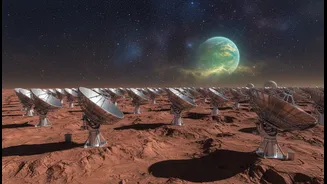
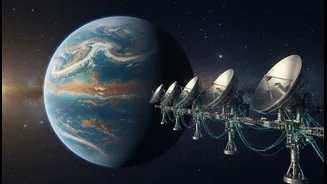
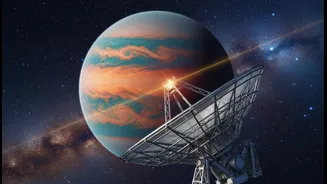
Because K2-18b remains such a tantalizing target, scientists are observing it with every tool at their disposal. This has led to a different kind of search using powerful radio telescopes. In a massive, coordinated effort, astronomers recently used the Very Large Array (VLA) in the United States and the MeerKAT telescope in South Africa to conduct one of the most sensitive radio surveys ever aimed at an exoplanet system. However, this search had a different goal. Instead of looking for the chemical fingerprint of DMS, this project was part of the Search for Extraterrestrial Intelligence (SETI) and was hunting for technosignatures—narrowband radio signals that would indicate the presence of advanced technology.
The Challenge of Finding a Signal
Searching for a faint, artificial signal from 124 light-years away is like trying to hear a whisper in a hurricane. Earth itself is a cacophony of radio noise from television, mobile phones, and satellites. The project's true innovation was the sophisticated technique developed to filter out this interference. The team analyzed millions of potential signals across a broad range of frequencies. They developed a multi-step data pipeline that automatically discarded known Earth-based transmissions and other noise. For instance, any real signal from K2-18b would show a slight frequency shift, or Doppler drift, due to the relative movements of our planets, so any signal that didn't drift was eliminated. This rigorous filtering process was a crucial proof of concept for future searches.
A Meaningful Silence
After observing the planet for its entire 33-day orbital period and sifting through the data, the result was silence. The team found no convincing evidence of radio transmissions coming from the K2-18b system. While this null result might seem disappointing, the scientific achievement is significant. The survey established a powerful new framework for conducting technosignature searches, one that is far more efficient and sensitive than previous attempts. This methodology is vital, as future projects with even more powerful instruments, like the Square Kilometre Array, will generate an unprecedented deluge of data that would be impossible to analyze manually. The search for signals on K2-18b may have been quiet, but it taught scientists how to listen better.