


A New Look at a Galactic Collision
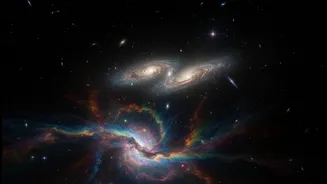
To mark the fourth anniversary of the James Webb Space Telescope's (JWST) science operations, NASA and the European Space Agency (ESA) have released a spectacular new image of Centaurus A. Located a relatively close 11 million light-years away, this galaxy
is the result of a colossal collision between two galaxies that happened about two billion years ago. Past telescopes, like Hubble, struggled to pierce the thick dust veiling the galaxy's core. But Webb’s infrared vision cuts straight through, revealing a stunningly dense tapestry of millions of individual stars. What was once a blurry glow is now a scene of galactic archaeology, where each point of light is a star that scientists can study to piece together the galaxy's violent and active history.
The Mysteries Within the Dust
The Webb telescope's view of Centaurus A does more than just show stars; it highlights the galaxy’s complex and beautiful dust structures in unprecedented detail. Images from Webb's Mid-Infrared Instrument (MIRI) show glowing, intricate shapes that have perplexed astronomers. A strange, parallelogram-shaped band of warped gas cuts across the galaxy's centre, alongside an unusual 'S' shaped feature. These unexpected structures raise new questions about the forces at play. At the heart of it all sits an active supermassive black hole, feeding on surrounding material and launching powerful jets of energy that shape the entire galaxy. Scientists are now working to understand how this black hole and the long-ago galactic merger influenced these bizarre and beautiful formations.
Euclid's Gaze into the Milky Way's Heart
While Webb deconstructs nearby galaxies, ESA's Euclid telescope is taking a wider view. In a recent observation, Euclid captured the largest and most detailed image ever taken in visible light of the Milky Way's crowded centre. The stunning picture is packed with more than 60 million stars, revealing the galactic bulge in a way that was previously impossible. Though Euclid's primary mission is to map the dark universe, this special observation provides a treasure trove for other fields of astronomy. For scientists hunting for planets outside our solar system, this image is a game-changer. It will help them confirm and measure the mass of exoplanets discovered through a technique called microlensing, where a star acts as a cosmic magnifying glass.
The Technology Driving Discovery
These incredible cosmic postcards are the product of immense technological achievement and international collaboration. The James Webb Space Telescope is a joint mission between NASA, ESA, and the Canadian Space Agency (CSA), representing a global commitment to fundamental science. Its giant, gold-coated mirrors and sensitive infrared instruments are the culmination of decades of engineering, designed to capture the faint light from the earliest days of the universe. Similarly, ESA's Euclid mission showcases European technological prowess in its quest to understand cosmic mysteries like dark matter and dark energy. Together, these observatories demonstrate how pushing the boundaries of technology allows us to answer age-old questions about our place in the universe. No single telescope can tell the whole story; each new instrument builds on the discoveries of those that came before.
Inspiring a New Generation
Beyond the scientific papers and data charts, these images have a profound cultural impact. They are a powerful tool for inspiring public curiosity in science and technology. For a country like India with a vibrant space program and a deep-rooted interest in astronomy, these images from NASA and ESA serve as both inspiration and a benchmark. They fuel the passion of students who might become the next generation of engineers at ISRO, or astrophysicists unlocking new secrets of the cosmos. When we see a star-forming region or the chaotic beauty of a galactic merger, we are not just looking at a distant object. We are looking at the raw materials of creation and the universal laws of physics in action, a vision that connects us all across borders.