



The Challenge of Dark Asteroids
Imagine trying to spot a piece of charcoal in the dead of night. That's the challenge astronomers face with dark asteroids. A significant portion of near-Earth objects are carbonaceous, meaning they are rich in dark, carbon-based materials that absorb
most of the sunlight that hits them. Unlike their shinier, more reflective cousins, they don't reflect enough light for optical telescopes on the ground to easily detect them. This creates a dangerous ambiguity: a faint speck of light could be a small, bright object or a massive, dark one. For planetary defense, knowing the difference is critical, as an undetected large asteroid could pose a significant threat.
Seeing with Heat Instead of Light
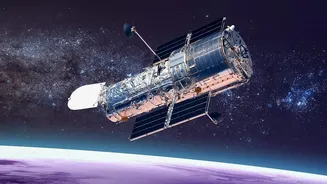
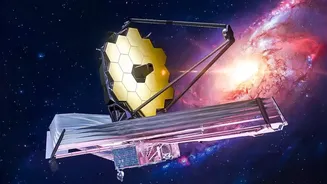
This is where infrared technology changes the game. Every object in space, no matter how dark, is warmed by the Sun. This absorbed energy is then radiated back into space as heat, which is invisible to the human eye but shines brightly in the infrared part of the spectrum. An infrared space telescope isn't looking for reflected sunlight; it's looking for these faint heat signatures. Against the intensely cold backdrop of deep space, a sun-warmed asteroid glows like a beacon. Crucially, an object's brightness in infrared is directly related to its size, not its reflectivity. This allows astronomers to spot both dark and light asteroids with equal ease and get a much more accurate estimate of their true size.
How the Technology Works
An infrared survey telescope works by repeatedly scanning large sections of the sky. When it captures an image, an asteroid appears as a warm point of light moving against a fixed background of distant stars and galaxies. To confirm a detection, scientists need multiple observations. By taking several images over a period of time, they can track the object's movement, which allows them to calculate its orbit and trajectory. This data is essential for determining if the object's path will bring it close to Earth. The 'combining' of data involves not just tracking movement over time but often using different infrared wavelength bands to better characterize the asteroid's properties.
Missions on the Front Line
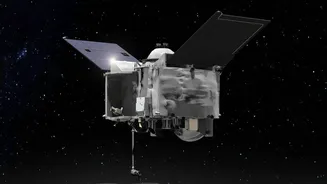
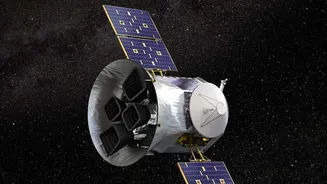
NASA has successfully proven this concept with the NEOWISE (Near-Earth Object Wide-field Infrared Survey Explorer) mission. Originally an astrophysics mission, it was repurposed to hunt for asteroids and has discovered thousands of near-Earth objects, making millions of infrared measurements. Building on this success, NASA is developing the NEO Surveyor, a next-generation infrared space telescope specifically designed for planetary defense. Scheduled for launch around 2027, it will be placed at a special vantage point between the Earth and Sun, allowing it to spot asteroids coming from the direction of the Sun—a major blind spot for ground-based observatories. The goal is to find at least 90% of potentially hazardous objects larger than 140 meters in diameter.
The Future of Planetary Defence
The development of advanced infrared telescopes marks a new era in planetary defense. By moving beyond the limitations of visible light, scientists can create a more comprehensive catalog of our cosmic neighbors. This is not just about finding asteroids but also about understanding them. Combining infrared data with observations from optical telescopes allows for precise calculations of both an object's size and its albedo (reflectivity). This information is vital for assessing the potential risk of an impact and for planning any potential mitigation missions. Missions like NEO Surveyor and Europe's planned NEOMIR represent a global commitment to proactively monitoring the skies and safeguarding our planet from a preventable natural disaster.