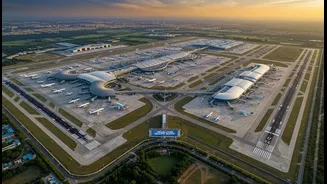










A New Challenger on the Tarmac
For decades, Indira Gandhi International (IGI) Airport has been the undisputed gateway to North India. But with the commencement of commercial operations at Noida International Airport on June 15, 2026, a new dynamic has emerged. Located in Jewar, Uttar
Pradesh, NIA is designed not just to absorb the ever-increasing passenger load of the region but to fundamentally redefine the travel experience. In its first phase, it has a capacity of 12 million passengers annually, a number projected to grow significantly in subsequent phases. But the real story lies in its strategic focus on a seamless, technologically advanced, and user-friendly journey.
The Gospel of Convenience
The core philosophy behind NIA, a greenfield project developed by Zurich Airport International AG, is built on convenience. This means a 'contactless and paperless' journey from the moment a passenger arrives. The airport has partnered with leading technology firms like Amadeus and SITA to implement a fully integrated passenger processing system. This includes self-service check-in kiosks, automated bag drops, and biometric-based DigiYatra integration at all touchpoints, aiming for a smooth and efficient flow. The design prioritizes shorter walking distances within the terminal, a common pain point in large airports, and a user-friendly layout that combines Swiss efficiency with Indian hospitality.
Strategic Location and Connectivity
One of NIA's most significant advantages is its location, which creates a new catchment area. It is poised to serve not only residents of Noida, Greater Noida, and Ghaziabad but also the vast population of Western Uttar Pradesh. For travellers heading to destinations like Agra or Mathura, NIA offers a clear time advantage over IGI. The airport is directly connected via the Yamuna Expressway, ensuring predictable travel times, a stark contrast to the often-congested routes to IGI. While metro connectivity is still in the planning stages, AC electric bus services are already operational, and a multi-modal transport hub is part of the long-term vision, integrating road, rail, and metro.
The Incumbent Responds
Delhi's IGI Airport, an established global hub, is not standing still. It has been consistently upgrading its own services to enhance passenger experience. IGI already has robust DigiYatra implementation and is leveraging artificial intelligence and machine learning to streamline airside operations, reduce delays, and improve baggage handling. To counter inter-terminal transfer issues, DIAL is introducing India's first driverless Air Train, an automated people mover that will connect its terminals, Aerocity, and the cargo complex, a significant upgrade expected to be operational between 2027 and 2029. With its extensive network of over 80 international destinations and superior metro connectivity via the Airport Express line, IGI retains a powerful advantage in reach and accessibility for many parts of NCR, especially Gurugram and West Delhi.
A Tale of Two Airports
The choice for travellers in the Delhi-NCR region is no longer automatic. It is now a strategic decision based on geography, destination, and personal preference. A resident of Greater Noida flying to a domestic location served by NIA will likely find the new airport far more convenient. However, a business traveller from Gurugram heading to an international destination will still default to IGI. In its initial months, NIA's route network is limited, with IndiGo and Akasa Air as launch carriers serving key domestic cities. International flights are expected to commence by the end of 2026. This phased rollout means that for the immediate future, the two airports will serve different, though sometimes overlapping, market segments. Another key factor is cost; a lower value-added tax on aviation fuel in Uttar Pradesh could incentivise airlines to offer more competitive fares from NIA.