

The Treasure in the Shadows
After the historic success of Chandrayaan-3, which made India the first nation to land near the lunar south pole, the Indian Space Research Organisation (ISRO) is planning its next giant leap. The focus is now shifting from simply landing to actively
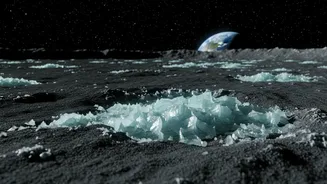
prospecting for a resource that could change everything: water. In a joint venture with the Japan Aerospace Exploration Agency (JAXA) called the Lunar Polar Exploration Mission (LUPEX), and with missions like Chandrayaan-4 on the horizon, ISRO is developing sophisticated tools to probe the Moon's most mysterious locations. The target is water-ice, which scientists believe has been preserved for billions of years in the coldest, darkest places on the lunar surface. Finding it in significant quantities would be a game-changer for humanity's ambitions beyond Earth.
What Are Permanently Shadowed Regions?
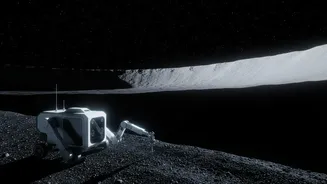
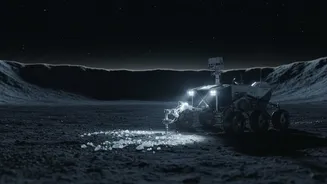
Imagine a crater so deep and located so close to a pole that its floor has never seen a single ray of direct sunlight. These are Permanently Shadowed Regions, or PSRs. The Moon’s axis has a very slight tilt of only 1.5 degrees, unlike Earth’s 23-degree tilt which gives us seasons. This unique orientation means that near the lunar poles, sunlight always strikes at a very low angle, skimming the horizon. The rims of deep craters can therefore cast permanent shadows, plunging their interiors into an eternal, deep freeze. Temperatures in these PSRs can plummet to as low as -250 degrees Celsius, making them some of the coldest spots in our solar system. These ultra-cold conditions act as perfect traps, preserving volatile compounds like water that would otherwise instantly vaporise in the vacuum of space. These ancient ice deposits could hold a pristine record of the early solar system.
The Tools for a Frigid Heist
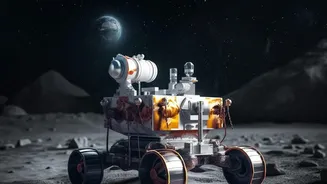
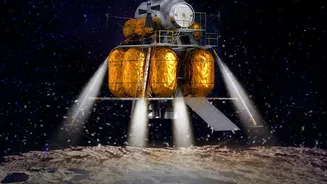
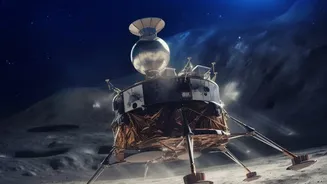
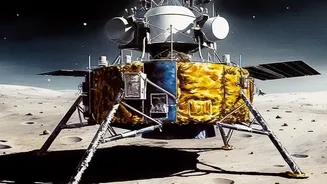
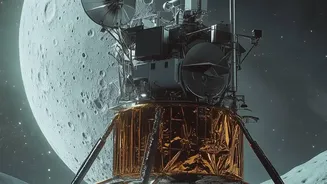
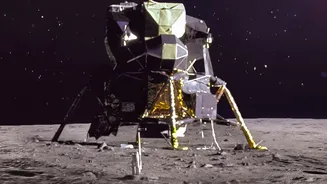
Exploring these dark, frozen craters requires a new generation of robotic explorers. For the LUPEX mission, scheduled for no earlier than 2028, ISRO is developing the lander, while JAXA is building the rover. This 350-kg rover will be a mobile laboratory on wheels, equipped with a suite of advanced instruments. Its key tool will be a drill capable of penetrating up to 1.5 meters below the lunar surface to collect soil samples. Onboard payloads, including a Neutron Spectrometer and a Ground Penetrating Radar, will help detect hydrogen—a key component of water—and map the distribution of any ice deposits beneath the surface. Instruments will heat the collected samples to analyse the released gases, directly measuring the quantity and quality of the water present. ISRO's Chandrayaan-2 orbiter has already provided crucial data, with its advanced radar detecting strong evidence of subsurface ice in these polar regions, helping to pinpoint the most promising sites for future landings.
Why Is Lunar Water So Important?
The high cost of space exploration is driven by one simple fact: launching mass from Earth is incredibly expensive. Every kilogram sent into space requires a huge amount of fuel. If future explorers can access resources on the Moon itself—a concept known as In-Situ Resource Utilisation (ISRU)—it would revolutionise space travel. Water is the ultimate resource. It can be purified for drinking and used to grow food. More importantly, it can be split into its constituent parts, hydrogen and oxygen, through electrolysis. This provides breathable air for astronauts and, crucially, the two key components of rocket propellant. A Moon with accessible water is not just a destination; it's a refuelling station for missions deeper into the solar system, such as to Mars.
India's Role in the New Space Race
ISRO's focus on lunar water places India at the forefront of a new, resource-driven space race. While the Outer Space Treaty of 1967 forbids any nation from claiming sovereignty over the Moon, it doesn't prohibit commercial operations. Nations and private companies are all eyeing the lunar poles as a strategic foothold for the future cislunar economy. Missions like Chandrayaan-4, which aims to be the first to return samples from the lunar south pole, and the collaborative LUPEX mission demonstrate India’s growing capabilities and its role as a key partner in international space exploration. By developing these technologies, ISRO is not only contributing to global scientific knowledge but also paving the way for a long-term human presence on the Moon, with a vision that includes a potential Indian astronaut landing by 2040.