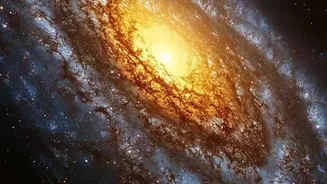


For decades, we’ve been told the universe is about 13.8 billion years old. Now, a new model from the University of Ottawa is challenging that fundamental number, suggesting our cosmos could be almost twice as old, at 26.7 billion years.
The Standard Picture: A 13.8-Billion-Year-Old Cosmos
Our current and
most widely accepted understanding of the universe is based on the Lambda-CDM model. This model explains the cosmos from its earliest moments, after a massive expansion event known as the Big Bang. By observing the afterglow of this event, called the Cosmic Microwave Background, and measuring how fast galaxies are moving away from us, scientists have confidently calculated the universe's age to be approximately 13.8 billion years. This figure has been the bedrock of cosmology for years, underpinning our theories about how everything from stars to galaxies formed and evolved over time.
Cracks in the Cosmic Egg
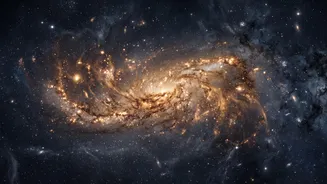
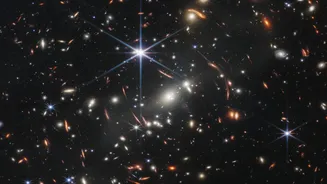
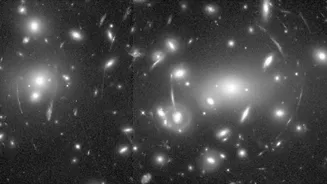
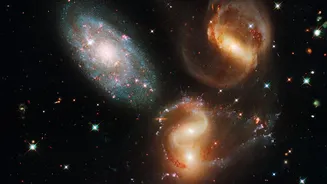
The launch of the James Webb Space Telescope (JWST) has given humanity its deepest-ever look into the early universe. What it found has been puzzling. The telescope has spotted galaxies that appear surprisingly large, mature, and massive for their age. According to the standard 13.8-billion-year model, these galaxies, seen existing just a few hundred million years after the Big Bang, shouldn't have had enough time to grow so large. This 'impossible early galaxy problem' has led some scientists to question if there might be a flaw in our understanding of the cosmos, opening the door for new theories.
A New Model: Doubling Down on Time
Enter a new model from University of Ottawa physicist Rajendra Gupta. His theory, called the CCC+TL model, proposes a universe that is 26.7 billion years old. This isn't just a random number; it's the result of combining two different ideas. The first is a century-old concept called 'tired light' theory. The second involves something called 'covarying coupling constants', which suggests that the fundamental forces of nature might not be as constant as we think. By weaving these two concepts together, Gupta’s model provides a much longer timeline for the universe's evolution.
What Is 'Tired Light' Theory?
'Tired light' was first proposed by astronomer Fritz Zwicky in 1929. The standard model explains that the light from distant galaxies appears redder—a phenomenon known as redshift—because the universe is expanding, stretching the light waves as they travel. Zwicky suggested an alternative: what if light simply loses energy as it travels across vast cosmic distances? This energy loss would also cause a redshift, but it wouldn't require the universe to be expanding in the same way. While this idea has been largely dismissed by mainstream physics due to conflicting evidence, Gupta's model revives a version of it.
And 'Covarying Coupling Constants'?
The second part of the model, 'covarying coupling constants' (CCC), challenges another core assumption of physics: that the fundamental forces governing particles are constant over time. Gupta's model proposes that these constants, which dictate the strength of forces like gravity and electromagnetism, may have evolved. If these forces were stronger in the past, it would change how we interpret everything from the light from early galaxies to the speed of cosmic expansion. This hybrid CCC+TL model suggests that the effects we currently attribute to dark matter and dark energy could actually be illusions caused by these changing forces.
So, Is the Universe Actually Older?
This new, nearly 27-billion-year age for the universe is, for now, a hypothesis. It’s a proposed solution to the 'impossible early galaxy problem'. By extending the age of the universe, the model gives those early galaxies billions of extra years to form and mature, making their observed size entirely plausible. The model has reportedly held up against several observational tests, successfully explaining galaxy rotation and the abundance of early elements without the need for dark matter. However, it represents a major departure from established science and will need to withstand intense scrutiny and further testing from the wider physics community before it can be considered a viable alternative to the trusted 13.8-billion-year figure.