




The Constant Call Home
Navigating in deep space has always been a conversation. Mission controllers on Earth send a signal to a spacecraft, which then sends it back. By measuring the time and frequency shift of this round trip, navigators can pinpoint a spacecraft's location
and speed. This system, primarily using giant antennas like those in the Deep Space Network (DSN), has guided probes to the farthest reaches of our solar system. However, this method has limitations. The DSN is a finite resource, already oversubscribed with dozens of active missions vying for time. As ambitions for the Moon and Mars grow, with hundreds of government and commercial missions planned, this reliance on Earth-based tracking is becoming a significant bottleneck, threatening to slow the pace of exploration. Every spacecraft needs to be meticulously managed from the ground, a process that is expensive, time-consuming, and leaves little room for autonomy.
Enter a Microwave-Sized Pioneer
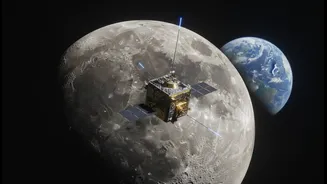
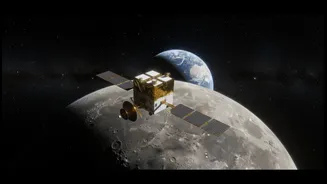
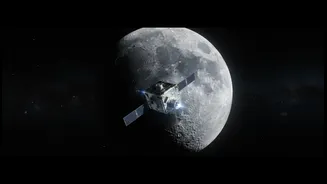
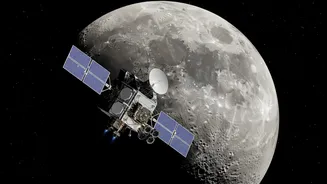
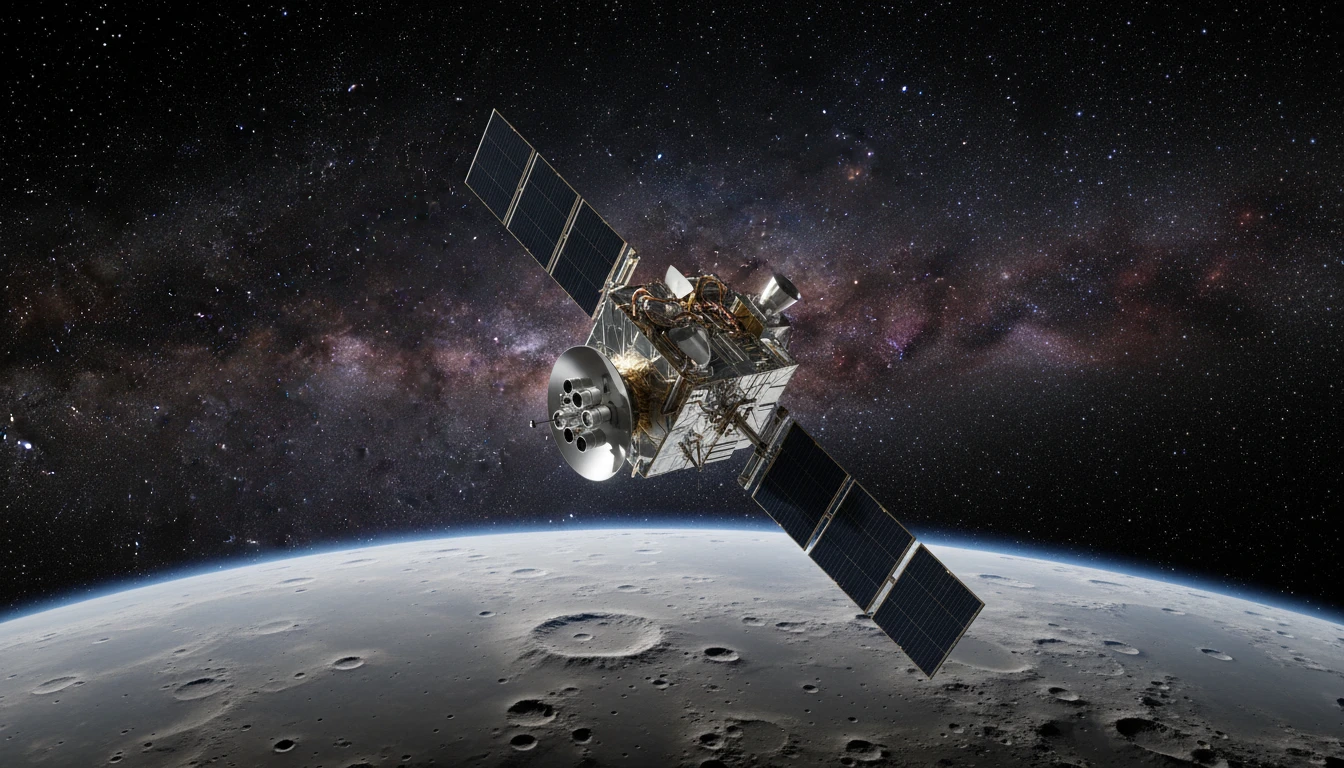
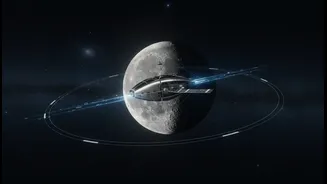
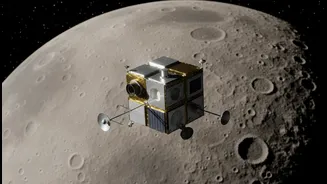
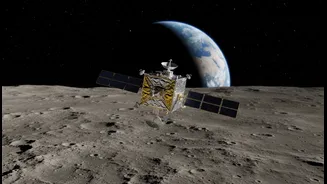
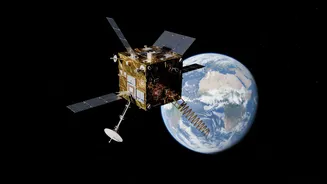
This is where a trailblazing mission called CAPSTONE comes in. Short for Cislunar Autonomous Positioning System Technology Operations and Navigation Experiment, this tiny, 25-kg satellite has been a quiet game-changer. Launched in June 2022, its primary goal was to test a unique, fuel-saving orbit around the Moon planned for future space stations like the Lunar Gateway. But its secondary objective holds the key to the future of navigation. CAPSTONE was designed to demonstrate that a spacecraft could determine its own position in lunar orbit without constantly phoning home. It successfully proved it could communicate with another orbiter—NASA's Lunar Reconnaissance Orbiter (LRO)—to determine its position, a crucial first step toward a self-sufficient navigation network. After completing its primary and extended missions, NASA concluded its work with the spacecraft in mid-2026, its objectives successfully demonstrated.
A GPS for the Moon?
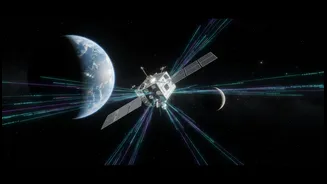
The technology tested by CAPSTONE is known as the Cislunar Autonomous Positioning System (CAPS). The concept is elegantly simple: instead of just talking to Earth, spacecraft can talk to each other. By sending signals between themselves, they can triangulate their positions relative to one another and the Moon. This creates a decentralised, peer-to-peer network analogous to how GPS works on Earth. Your phone doesn't talk to a mission control centre; it listens for signals from a constellation of satellites to figure out where it is. CAPS aims to create a similar framework for the Moon. This doesn't mean replacing Earth-based systems entirely, but rather complementing them, adding a new layer of redundancy and autonomy that makes lunar operations more robust and flexible.
Why This Changes Everything
The implications of this shift are enormous. Autonomous navigation makes space missions more efficient, scalable, and resilient. By reducing the reliance on the DSN, it frees up Earth-based assets for more critical tasks, like deep-space science from probes far beyond the Moon. It dramatically lowers operational costs and complexity, making lunar missions more accessible to a wider range of commercial companies and national space programs, including India's ambitious Chandrayaan missions. Spacecraft will be able to perform complex manoeuvres, rendezvous, and land with greater precision and without waiting for instructions from a distant Earth. This capability is not just a convenience; it's a foundational requirement for building and maintaining permanent infrastructure like lunar bases, communication relays, and fuel depots.
The Dawn of a Lunar Network
CAPSTONE was just the beginning. The success of its navigation experiments, along with other recent demonstrations like the Lunar GNSS Receiver Experiment (LuGRE), which successfully used Earth's GPS signals at the Moon, has validated the concept of a dedicated lunar navigation network. NASA is now developing LunaNet, a framework of interconnected systems that will provide communication and navigation services for all lunar explorers, much like the internet on Earth. International partners, including Japan with its proposed Lunar Navigation Satellite System (LNSS), are also developing their own components for this burgeoning ecosystem. These systems will allow future astronauts, rovers, and landers to navigate the Moon's rugged terrain with an accuracy that was unimaginable during the Apollo era, paving the way for a sustained human and robotic presence on our celestial neighbour.