






A Steamy Cosmic Cradle
Scientists have aimed the powerful infrared eyes of the JWST at a young star system named PDS 70, located approximately 370 light-years from Earth. Swirling around this star is a vast protoplanetary disk—a massive ring of gas and dust where new planets
are actively being assembled. For the first time, Webb detected the unmistakable signature of water vapour in the inner region of this disk. This area, less than 160 million kilometres from the star, is the equivalent of the zone where Earth and other rocky planets formed in our own solar system. While scientists have found water in other disks before, this is the first time it has been spotted so close to the star in a system already known to be forming planets.
The Right Tool for the Job
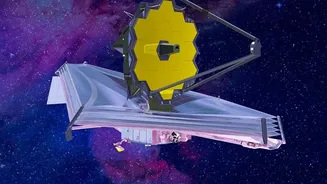
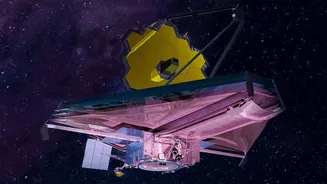
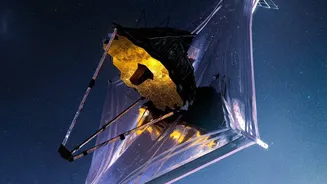
Detecting this water was a task only the JWST could handle. The telescope’s Mid-Infrared Instrument (MIRI) is specifically designed to peer through cosmic dust and analyse the heat signatures of molecules. As the light from the star system travels towards the telescope, the water vapour absorbs specific wavelengths of light, leaving behind a chemical fingerprint. By analysing this spectrum, astronomers confirmed the presence of hot water vapour, with temperatures around 230 degrees Celsius. Previous telescopes simply didn't have the sensitivity or the capability to make such a precise measurement in the dense, complex environment of a planet-forming disk's inner region. This breakthrough is a testament to the revolutionary power of the Webb telescope.
Why This Water Matters So Much
Finding water is always exciting, but its location here is what makes this discovery truly profound. For decades, a key debate among scientists has been how Earth got its water. One leading theory is that it was delivered much later in our planet's history by icy comets and asteroids bombarding the surface. However, the detection of water vapour within the terrestrial-planet-forming zone of PDS 70 suggests a different possibility. It implies that rocky planets can have water available as a fundamental ingredient from the very beginning of their formation. Instead of waiting for a delivery, future Earth-like worlds could be born with their own local reservoir of water, significantly increasing the chances of them becoming habitable.
The Blueprint for a Habitable Planet
The PDS 70 system is a fascinating natural laboratory. It not only has this inner disk rich with water vapour and silicate dust—the raw materials for rocky worlds—but it also hosts two known gas-giant planets orbiting further out. The presence of this water means that any rocky planet forming in that inner zone would be born into a water-rich environment. This dramatically changes our understanding of planetary evolution. It suggests that the conditions necessary for life as we know it might not be a rare cosmic accident, but a common feature of planet formation across the galaxy. This discovery provides a crucial piece of the puzzle, connecting the dots between star birth, planet formation, and the origins of habitable worlds.
What Comes Next in the Search
This discovery is not an end, but a spectacular beginning. Astronomers are now eager to learn more about the water's origin within the PDS 70 system. Is it forming in place, or is it being transported from the colder, outer regions of the disk? Further observations with the JWST will aim to map the distribution of water and other key molecules, like carbon, to build a complete picture of the chemistry at play. While no rocky planets have been detected in the inner disk yet, the presence of their building blocks is undeniable. Each new observation from Webb brings us closer to answering one of humanity’s oldest questions: Are we alone in the universe?