



A Universe of Invisible Light
Our eyes are incredible, but they only see a tiny fraction of the light that exists. This visible spectrum, from violet to red, is just one part of the vast electromagnetic spectrum. Beyond red lies infrared, a wavelength of light we can't see but can often
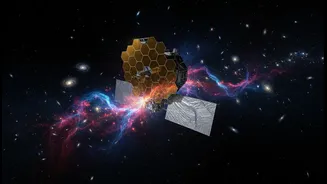
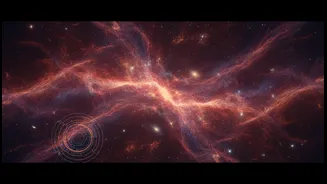
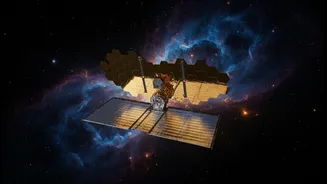
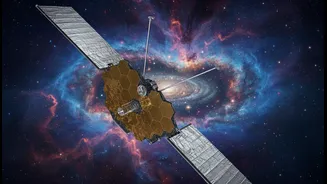
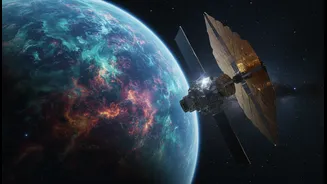
feel as heat. The James Webb Space Telescope is an engineering marvel designed specifically to see the universe in near- and mid-infrared light. This isn't just an upgrade from telescopes like Hubble, which primarily sees visible light; it's a fundamentally different way of observing the cosmos, giving JWST a set of cosmic superpowers. Its massive, gold-coated mirror, over 6.5 metres wide, is optimized to collect these longer, fainter wavelengths of light that have travelled across billions of years to reach us.
Piercing Through Cosmic Dust
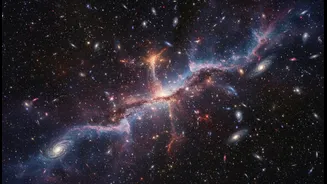
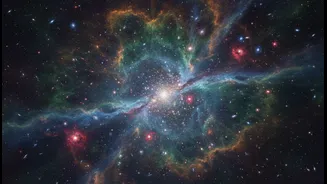
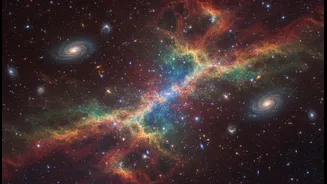
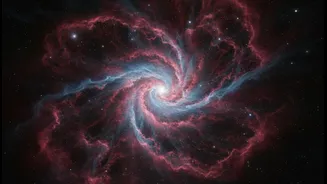
One of infrared's greatest advantages is its ability to pass through the immense clouds of gas and dust that drift through space. These cosmic clouds, which appear dark and opaque to telescopes like Hubble, are stellar nurseries where new stars and planets are born. Visible light gets scattered and blocked by the dense dust, hiding the action within. But infrared light can penetrate this dusty veil, allowing astronomers to peer inside. A perfect example is Webb's stunning view of the Pillars of Creation. While Hubble made the pillars famous, showing them as majestic, shadowy columns, Webb's infrared gaze looks straight through the semi-transparent gas to reveal the bright red, newly formed stars that were previously hidden inside them. This allows scientists to get a far more precise count of newborn stars and refine their understanding of how stars come to life.
A Time Machine to the Dawn of Everything
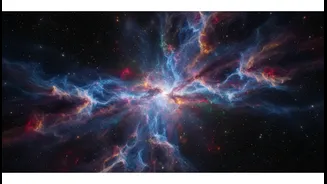
Webb’s second superpower is its ability to act as a time machine. The universe has been expanding since the Big Bang, and this expansion stretches light as it travels across the cosmos. Light that was emitted from the very first stars and galaxies as visible or ultraviolet light has been stretched over 13 billion years into the infrared spectrum by the time it reaches us. This phenomenon is called 'redshift'. Because Webb is optimized to detect this faint, ancient infrared light, it can see objects that are too old and distant for Hubble. It has already captured images of galaxies that formed just a few hundred million years after the Big Bang, giving us an unprecedented glimpse of the cosmic dawn. We are, in effect, seeing snapshots of what the universe looked like over 13.5 billion years ago.
More Than Just Pretty Pictures
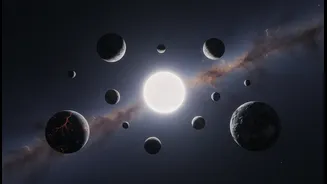
While the images are breathtaking, Webb's infrared capabilities are also a powerful tool for scientific analysis. By studying the infrared light that passes through the atmospheres of planets orbiting other stars (exoplanets), astronomers can detect the chemical fingerprints of different molecules. This process, called spectroscopy, allows them to analyze what these distant atmospheres are made of. Detecting the presence of molecules like water, methane, and carbon dioxide could provide crucial clues in the search for habitable worlds beyond our own solar system. Recently, the telescope's power has been used to study the complex chemistry on frozen worlds in our own solar system, like Pluto and Titan, revealing molecular signals that are still being identified. Webb’s vision isn't just showing us what the universe looks like; it’s telling us what it’s made of.