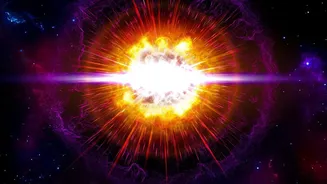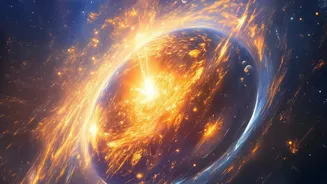



In 1604, a brilliant 'new star' appeared in the sky, baffling observers across the globe. Today we know it as Kepler’s Supernova, a dramatic stellar explosion whose story bridges Renaissance astronomy and modern astrophysics.
It Was the Last Supernova Seen in Our Galaxy
SN 1604 holds a special place
in history: it is the most recent supernova to have been definitively observed with the naked eye within our own Milky Way galaxy. While other supernovae have occurred in our galaxy since, like Cassiopeia A around 1680, they were obscured by interstellar dust and went unnoticed by observers on Earth. For over 400 years, we have not witnessed another such event in our galactic home. At its peak, SN 1604 was brighter than any star or planet in the night sky, with an apparent magnitude of -2.5, and was even visible during the day for over three weeks. Its appearance was documented by astronomers in Europe, China, Korea, and the Arabian Peninsula.
Johannes Kepler Was Not Its First Observer
Although the event is famously named after German astronomer Johannes Kepler, he was not the first to spot it. The first recorded observation in Europe was made on October 9, 1604, by Ludovico delle Colombe in Italy. Kepler, working in Prague, only began his own detailed observations on October 17. However, it was Kepler's comprehensive year-long study and his subsequent publication, 'De Stella nova in pede Serpentarii' ('On the New Star in the Foot of Ophiuchus'), that cemented his association with the celestial event. His meticulous work, done entirely without a telescope, provided crucial data that challenged the long-held belief in perfect and unchanging heavens.
It Was a 'Type Ia' Supernova
Modern astronomers have classified SN 1604 as a Type Ia supernova. This type of cosmic explosion occurs in a binary star system, where two stars orbit each other. The event is triggered when a small, dense star called a white dwarf siphons off too much material from its companion star. Once the white dwarf exceeds a critical mass, it triggers a runaway thermonuclear reaction, resulting in a cataclysmic explosion. These Type Ia supernovae are incredibly important to astronomy because they explode with a predictable and consistent brightness, allowing scientists to use them as 'standard candles' to measure vast cosmic distances and even the expansion rate of the universe.
Its Remnant is a Laboratory in the Sky
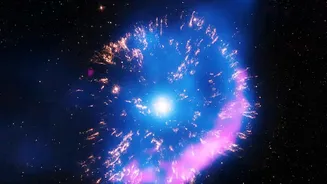
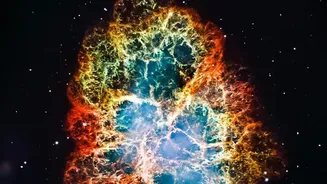
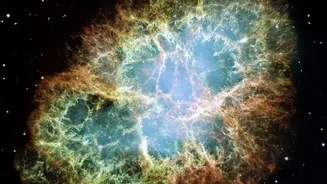
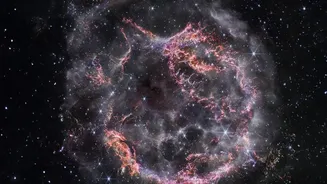
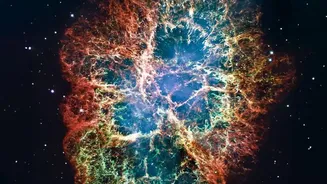
What remains of the 1604 explosion is a beautiful, expanding cloud of gas and dust known as Kepler's Supernova Remnant. Located approximately 16,000 to 20,000 light-years from Earth, this remnant is a prime target for modern observatories like NASA's Chandra X-ray Observatory and the Hubble Space Telescope. The remnant spans about 14 light-years wide and is expanding at incredible speeds, with some material clocked at over 20 million miles per hour. By studying the shape and composition of the remnant, astronomers can learn about the explosion itself and the interstellar environment it is expanding into. For instance, its asymmetrical shape suggests the expanding debris is colliding with a dense cloud of gas and dust.
A Lingering Progenitor Mystery
While scientists are confident SN 1604 was a Type Ia event, the exact details of its progenitor system—the stars that caused it—are still debated. One leading theory suggests the white dwarf was pulling material from an evolving giant companion star. Evidence for this includes the presence of a disk-like structure and certain elements like nitrogen and magnesium in the remnant, which would have come from the companion. However, a major puzzle remains: if the companion star survived the blast, as it should have in this scenario, where is it? Despite deep searches, no surviving companion has been found, keeping the exact origin story of Kepler's Supernova a compelling astronomical mystery.