


The Old Rule of Thumb
For years, climate models and ecological theories operated on a straightforward principle. The journey for water from a tree's roots to its highest leaves is a battle against gravity and friction. The taller the tree, the greater the distance, and the harder
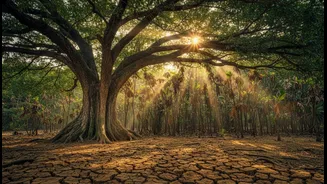
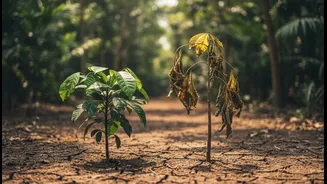
its internal plumbing must work. This led to the logical conclusion that in a hotter, drier world, the majestic giants of the rainforest would be the first to suffer. It was believed that the immense strain of pulling water hundreds of feet into the air would make them especially susceptible to hydraulic failure during prolonged droughts, where the water column inside the tree can snap, leading to death. This assumption was woven into predictions about how these vital ecosystems would fare under increasing climate stress.
A Challenge from the Canopy
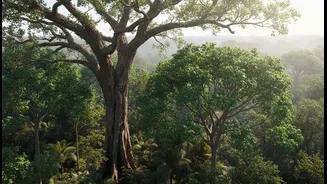
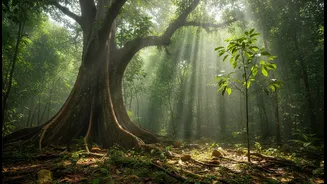
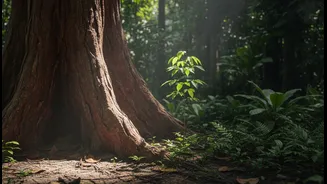
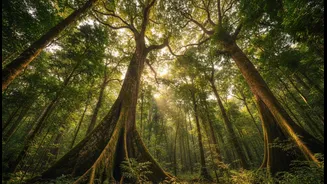
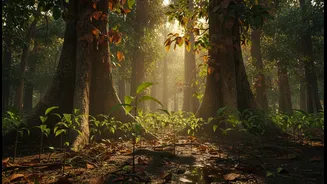
To test this long-held idea, a team of scientists travelled to the Kabili-Sepilok Forest Reserve in Malaysian Borneo, home to some of the planet's tallest tropical trees. Working with skilled professional climbers, researchers scaled giant dipterocarp trees, some soaring over 230 feet, to collect samples from the base to the crown. Published in the journal Science, their findings directly contested the old rule. The study revealed that these towering trees have developed remarkable adaptations to overcome the challenges of their own height. This wasn't just a theory; their research coincided with a severe El Niño-related drought from 2023 to 2024, providing a perfect real-world stress test. When the team measured growth rates, they found no evidence that taller trees suffered more than their shorter neighbours.
An Elegant Inner Workaround
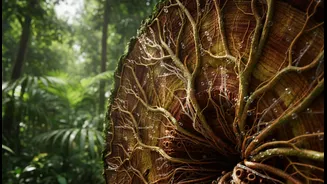
So, what is the secret to their resilience? The study uncovered that the trees essentially re-engineer their own internal plumbing as they grow. The water-carrying tubes, known as xylem, were found to be significantly wider at the base of taller trees. Think of it like upgrading from a narrow straw to a wide pipe; this anatomical change dramatically reduces resistance, allowing water to flow upwards more efficiently despite the immense vertical distance. Furthermore, the leaves at the very top of the canopy showed adaptations to function better under lower water pressure, making them more resistant to wilting. These biological tweaks effectively compensate for the physical disadvantages of being tall, ensuring the entire tree remains hydrated even during dry spells. This suggests resilience is less about sheer size and more about a species' specific internal toolkit.
A New Blueprint for Prediction
This discovery marks a significant shift in how scientists must approach forecasting forest health. Instead of relying on a simple variable like height, models will need to incorporate the specific 'hydraulic traits' of different tree species. It highlights that the future of tropical forests, which are critical carbon sinks, cannot be predicted with a one-size-fits-all approach. The lead author of the study noted that because existing predictions assumed a weaker hydraulic system in tall trees, they were often marked as being at a higher risk of dying. This new evidence suggests that, at least for some species, this may not be correct. The findings force a more nuanced view, where a tree's internal anatomy and evolved strategies are just as important, if not more so, than its external dimensions. This complexity makes forecasting more challenging but also more accurate.